


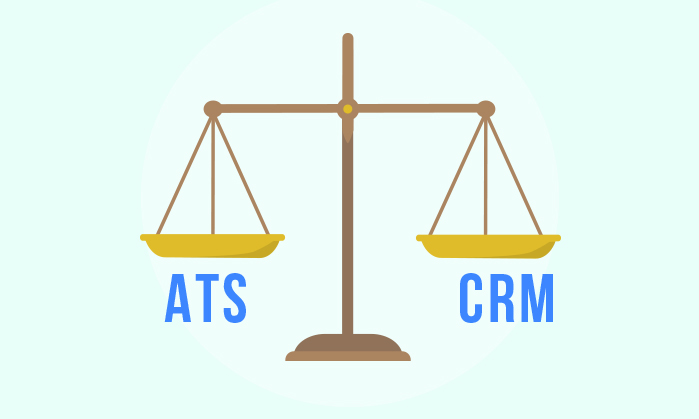
The ATS vs CRM debate is not new, but if it is for you, this is the time to make sure you understand the alphabet soup and are completely clear on what both products can offer.
Even the best software in the world can’t fix lazy recruiting, but getting the right tech stack can save you time, money and put you leaps and bounds ahead of competitors.
ATS: Your applicant tracking system is a repository for applicants and manages the application process. It’s often a compliance requirement and it’s the system of record that recruiters traditionally rely on.
CRM: Your candidate relationship management system is for job seekers and candidates. It’s the engine that drives your sourcing team, lets you create talent pools, and helps you build and nurture relationships with passive talent.
Put simply, your ATS is a workflow and compliance tool that manages applicants, your CRM is an ecosystem of all passive and active candidates, as well as everyone who has previously applied to your company. It’s a complete talent intelligence hub.
As the level of automation, automation, and technology increases, the way people are hired will change, and the way your business communicates with candidates will evolve. Technology is great at listing the functions your company’s website should include, but it can be lacking when it comes to details like how long your careers page should be, and what the featured spot should be. The truth is that the ATS vs CRM comparison can be really confusing for organizations, both for recruiting professionals and for hiring managers. So, what are the main features to consider?
The main function of these systems is to streamline the hiring process and create a level playing field for all applicants. Here are a few basic features to look for in each system:
While there can be a lot of overlap between ATS and CRM, the ATS is definitely housing all of your leads and candidates in one central database. Some companies have an ATS on the cloud and a CRM that leverages the data in the ATS or vice-versa.
ATS
Although you can use your ATS as a one-stop-shop, it’s much more efficient to use your ATS and CRM in unison. This will ensure that you’re capturing data from all eligible candidates, and your CRM will help you manage lead-to-hire processes for sales and marketing reps who need to follow up with leads.
‘CRM’ is an acronym of ‘Customer Relationship Management,’ so a CRM system should enable you to have a better relationship with your customers. Now for us, this is why a lot of the standard big-name CRM systems can struggle to fit our industry sector.
As recruiters, we have one customer; however, that one customer has a potential dual role of a candidate and client. Therefore, we require two different types of relationships with the – client by day, and potentially candidate by night. The information, data, communication methods, and channels we use to interact with that one person on two levels could be completely different.
So for recruiters, a CRM system needs to not only be able to cope with but thrive on these differences. We need insight, analytics & a way to communicate across these two areas that don’t pigeon hole or stifle our relationship with our customer. Which we could all agree is the complete opposite of what your CRM should be doing.
On top of that, your CRM site needs to be built to scale up from your first couple of leads in your earliest stages right through to the millions you can acquire for your clients in the biggest of firms. It needs to be able to adapt to you as you grow, creatively, and organically. You need to be able to meet the needs of your team. You need a CRM system that understands your business, is built for you so it can cater to your methodology and your growth, and supports you every step of the way.
Your CRM system should be built for the whole lifecycle of your candidate, from sourcing to hiring and, finally, to retaining customers. So you can manage all your processes across all aspects of your transition to help you to have a complete capture of your candidates throughout.
CRM
The best CRMs are easy to use and understand, and have a complete collection of features for recruiters and hiring managers. Business data is centralized, displayed in relevant ways, and presented in an intuitive interface that makes it easy for you to capture all the information you need. It’s an all-in-one solution that gives you the ability to:
- Source Recruitment: Your CRM can access every information source you can think of and build data about the candidates and talent you’re sourcing.
- Job Ad Management: Posting job ads and managing the candidate experience within your job ads can be critical to how successful you are at hiring.
- Quality Assurance: When you have the ability to rate every candidate you come across, you can take a nuanced approach to make sure you’re finding the best candidates.
- Talent Profiling: Candidate profiling is a helpful feature of many CRMs. You can rate candidates on the specifics of your job description, so you can pass on only the best, most qualified applicants.
- On-boarding: Whether it’s new hires or new hires, you can automate time-consuming tasks and save a lot of time in the process.
- Interview Scheduling: Your CRM will enable you to schedule interviews and check candidates’ availability.
- Reporting: You’ll need to look at your top talent acquisition sources and tactics (and spend more time doing what works and less on what doesn’t). You can also spend less time on administrative tasks like managing candidates and more on growing your business.
The Top CRM Features Your Recruiters Will Love:
- Customisation to fit your business needs: You shouldn’t be adapting to your CRM; your CRM should be adapting to you and your business.
- Easy to use reporting: This allows you to identify competitors, faster.
- Comprehensive automation: It can reduce manual hours while your team moves up the value chain.
- Seamless integrations: Allows nearly complete automation of your data capture, management tasks, and job role-specific processes.
- Flexible enough to be configured to match your own hiring process.
These key capabilities allow you to nurture your leads and candidates in a closed-loop system, based on their individual needs. And it allows you to make better, data-driven decisions on how you communicate with them, bringing some form of structure and tracking to your outreach efforts.
The other thing that CRM systems are fantastic at is giving you visibility into your business that you might not have had before. As mentioned previously, the ATS vs CRM debate can be one of the most confusing things when it comes to choosing your talent acquisition toolkit. This is because, in essence, they have similar functions.
If you are going through the process of choosing between an ATS and CRM system, how do you decide between the two? What are the key considerations you need to think about? What is the top reason why you should choose a traditional ATS system, and why a CRM is the better choice?
How To Choose A CRM System For Recruiters
If you’re planning to work with a recruitment agency, check out our guide to making the most out of agency partnerships.
Search and select the best talent acquisition solutions for sales, marketing, and management teams.
Every On-Demand Recruiter is different. One may run a landing page contest to win a dream internship on the beach in Tahiti. While another may be looking for you to recruit your next $1 billion customers.
While your business is unique, there are a few traits most On-Demand Recruiters have in common. So we created this checklist to highlight all the specific traits On-Demand Recruiters will want in a talent acquisition solution.
The 5 Things Every On-Demand Recruiter Wants in Their ATS:
- Save time and money: Check off. You save money because you’re not filling positions that probably don’t need filling. You save time because you’re using automation, like pre-qualifying candidates, to reduce the amount of time you spend looking at bad applications.
- Scale with your business: Yes. This is one of the biggest challenges you’ll face as your business grows and you hire more staff. You need to be able to grow with your business.
- Collaboration: As you gear up to grow your team, you will want to make sure everyone is on the same page. They need to be able to answer the same success questions: Who is our star candidate? Why would they want to work here? How likely are they to join the team?
- On-demand access: You can’t be a successful On-Demand Recruiter if you are stuck in the old ways. You need to be working in real-time; with access to the tools you need whenever you need them. This is why On-Demand Recruiters often rely on cloud-based enterprise software.
- See ATS vs. CRM in the big picture: You need your talent acquisition solution to be more than a way to manage the day-to-day. You need to be able to see the bigger picture and understand the business value of great talent acquisition.
Want To Know What Else All On-Demand Recruiters Will Need? Our On-Demand Recruiter Buyer’s Guide
Just like you need your recruitment CRM to automate the things that can be automated, you need your email automation to be effective and give your candidates/prospects exactly what they want.
So if you’ve fallen prey to bad email automation, we’ll help you avoid it. Then, if you’re using good email automation or are going to be starting soon, you’ll know what to look out for.
What Is Email Automation, And Should You Use It in Your On-Demand Recruitment Strategy?
Nowadays, email automation is already a vital part of every recruitment campaign, and it will keep getting more and more important as the years go by. The fact is email automation is a must-have tool for today’s on-demand recruiter. It can save you time and boost your team’s productivity, but only when used correctly.
In the past, you may have missed the opportunity to acquire a great candidate because you sent out a job description far too late or not long enough email automation. Today it’s easy to know if those candidates have already been hired or are no longer interested.
Email Automation Can Help You Learn:
- what candidates or prospects want from your job description format
- if they’re suitable for a job or not
- when they need a job
- how long they’re willing to wait to get that job.
But email automation is more than a great tool to learn about candidates, it is also an essential part of sales and marketing strategy.
There Are Many Benefits of Email Automation Including:
- Helping You Understand What is Working and What Isn’t: With email automation, you’ll know what is working best for your business, whether it’s by how many submissions, clicks, or conversions you get.
- With email automation, you’ll know what is working best for your business, whether it’s by how many submissions, clicks, or conversions you get. Speed up the Sales Process: On-demand recruitment requires speed. Email automation can allow your team to move faster, pull data to drive the next action, and keep track of what’s working.
- On-demand recruitment requires speed. Email automation can allow your team to move faster, pull data to drive the next action, and keep track of what’s working. Simple Marketing: Email automation allows you to open new lead sources and promote your services.
- Email automation allows you to open new lead sources and promote your services. Reduce manual work: This frees your team up to focus on other aspects of your business. For example: running your job board.
- This frees your team up to focus on other aspects of your business.