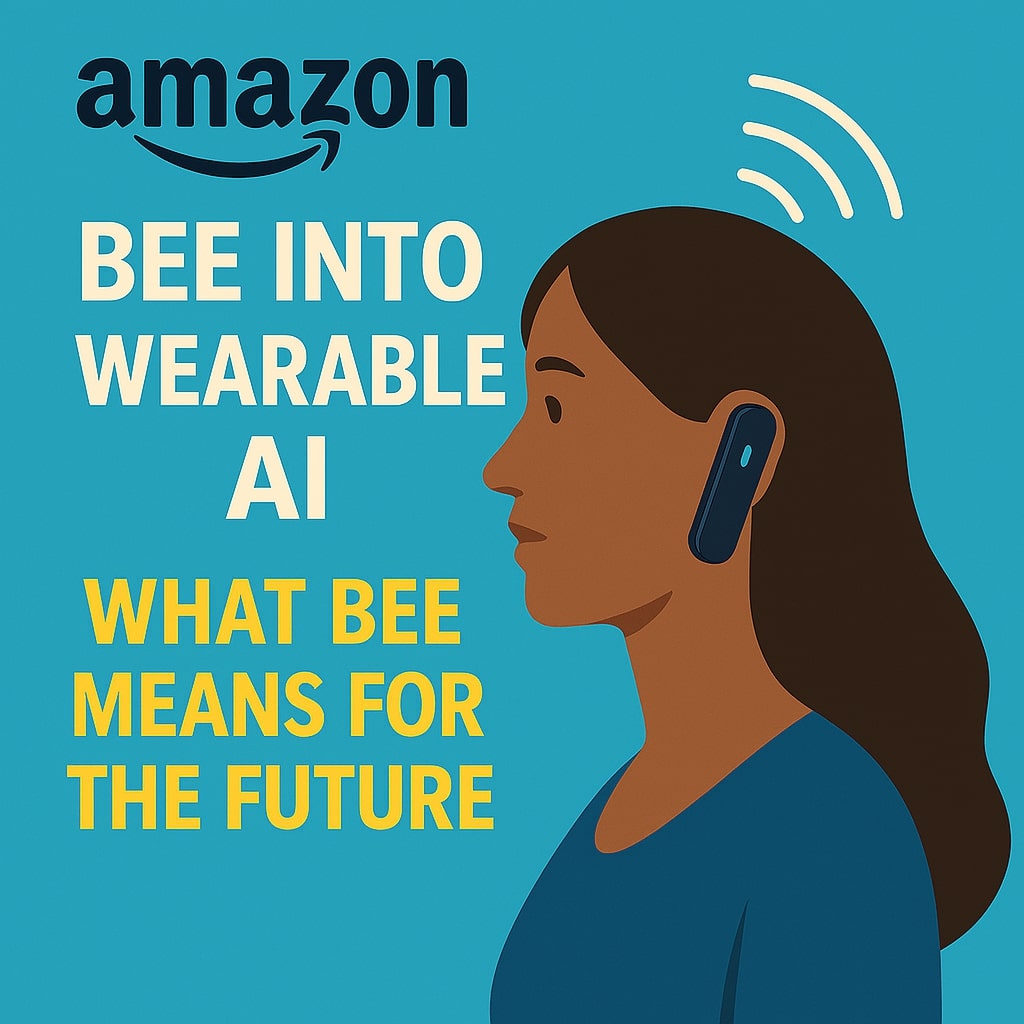
Amazon has just confirmed the acquisition of Bee, a startup that created a $50 AI wearable device capable of passively listening to your daily interactions. This tiny piece of technology, discreetly worn on the collar or wrist, is more than just a futuristic accessory. It is Amazon’s most striking entry into the AI wearable device market to date.
In a move that combines consumer convenience with artificial intelligence advancement, this acquisition shows just how far Amazon is willing to go to rewire the way we interact with our environments. The Amazon Bee acquisition may seem modest in dollars and scale, but the implications are enormous — from productivity to privacy.
What is Bee and Why It Matters
Bee, the startup in question, developed a compact AI-powered wearable that can constantly listen to conversations, analyze context, and offer support through a connected device. Think of it as Alexa for the physical world, only smarter and always with you.
Its core function is to gather audio data in real time and send intelligent summaries or insights back to users whether for personal journaling, productivity tracking, or even early healthcare alerts. The device can be clipped onto clothing and operates independently or in sync with smartphones.
For Amazon, the acquisition is not just about adding another gadget to its ecosystem. It is about deepening its hold on ambient computing — the next era of tech where devices disappear into your surroundings but are always working for you.
Amazon’s Larger AI Strategy
This announcement comes on the heels of Amazon revamping Alexa with generative AI, unveiling new machine learning tools for developers, and ramping up cloud AI offerings on AWS.
By acquiring Bee, Amazon is making a clear statement. It does not want to merely participate in the AI wearable device race. It wants to lead it.
This device fits into Amazon’s broader push to connect devices and services through intelligent assistants that can understand user behavior over time. Amazon’s earlier investments in fitness wearables, smart glasses, and Alexa-powered earbuds now look like stepping stones toward a more immersive AI layer.
Privacy Backlash and Public Reaction
Naturally, the Amazon Bee acquisition raises privacy concerns. Critics worry that a device designed to record and interpret conversations could be weaponized for surveillance, even unintentionally.
Bee’s technology is supposed to anonymize and encrypt all captured audio, storing only processed summaries. However, in a post-Cambridge Analytica world, the public’s trust in tech giants remains shaky.
Amazon claims that data collection will follow strict privacy protocols, with transparency reports and user consent dashboards. But will that be enough to prevent backlash?
Regulatory bodies across the US and Europe are already watching closely, with several AI watchdogs questioning whether passive listening tools can be made ethical at scale.
Market Reactions and Future Implications
Investors responded positively to the news, with Amazon shares climbing slightly following the announcement. Market analysts suggest that the AI wearable device category could grow into a $20 billion industry by 2028.
The Bee acquisition puts Amazon in direct competition with Meta’s Ray-Ban smart glasses and Google’s AI integrations in Pixel Buds. However, unlike visual AR, Bee’s auditory focus could give Amazon an edge by targeting a different sensory frontier.
For startup founders, this is also a sign that innovation in sensory computing is ripe for acquisition. Smaller players in the AI wearable space now have validation that exits are possible, even with limited initial funding.
Final Thoughts: A Buzzing Future Ahead
Amazon’s acquisition of Bee signals a deeper shift in how we think about interaction, productivity, and privacy. The AI wearable device category is no longer theoretical. It is being built, bought, and rolled out in real time.
From voice-enabled homes to body-worn digital assistants, the line between human and machine interaction is blurring. Bee might look like a modest clip-on gadget today, but it could reshape how people manage daily life tomorrow.
Will consumers adopt it eagerly, or will privacy advocates sound the alarm? Only time will tell. But one thing is clear Amazon is betting big on a world where machines are always listening, always learning.
As AI continues to mature, Meta’s push toward automated advertising signals a broader transformation in how brands connect with audiences faster, smarter, and more intuitively than ever before follow welp magazine for more information.