Updated Mar 23 2026 | 11:12 PM GMT+5:30
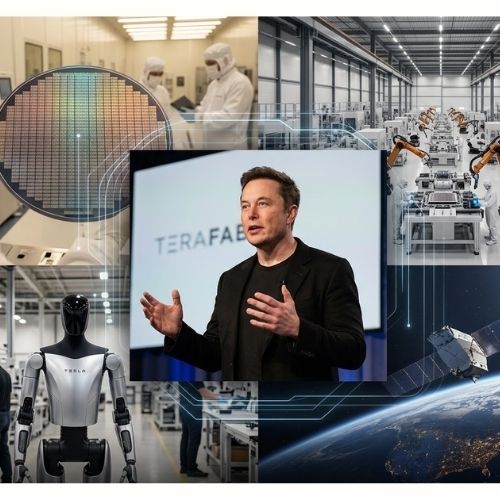
When Elon Musk introduced Terafab in Texas, it was presented as a bold step into semiconductor manufacturing. But the announcement is less about building another chip plant and more about solving a problem that is quickly becoming central to the future of artificial intelligence: access to compute.
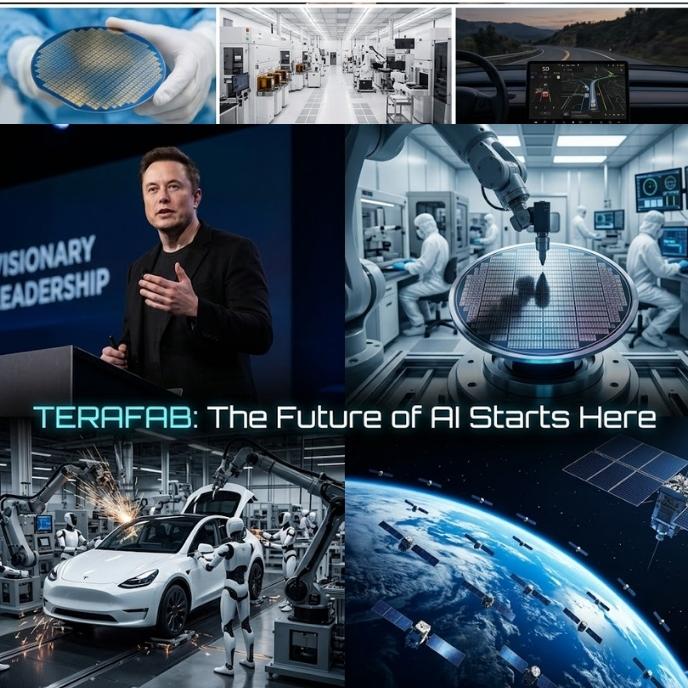
Musk’s companies, including Tesla and SpaceX, are entering a phase where demand for advanced chips is accelerating faster than the global supply can keep up. Terafab is his attempt to close that gap internally.
The Real Problem: Compute Is Becoming Scarce
AI development today is no longer limited by ideas or models. It is limited by hardware.
As systems become more complex, the need for high performance chips grows exponentially. Tesla’s autonomous driving ambitions, its humanoid robot program, and the expansion of AI systems all rely on continuous access to advanced semiconductors.
Right now, that supply comes from external partners such as Taiwan Semiconductor Manufacturing Company and Micron Technology, along with manufacturing agreements involving Samsung Electronics.
These relationships remain important, but Musk has made it clear they may not scale fast enough for what comes next.
Terafab is designed to reduce that dependency.
What Terafab Actually Plans to Do
At this stage, Terafab is still an early concept rather than a fully defined project. There is no confirmed construction timeline, and the scale of the build remains flexible.
Initially, the facility is expected to operate as an advanced fabrication and testing center. Over time, it could evolve into a larger semiconductor operation capable of producing chips at cutting edge nodes such as 2 nanometers.
The long term goal is to support large scale compute output, potentially reaching 100 to 200 gigawatts annually on Earth. That level of production would make Terafab a meaningful player in the global semiconductor landscape, but achieving it would require years of development and significant capital investment.
Two Parallel Tracks: Earth and Orbit
Musk’s plan for Terafab is split across two distinct use cases.
The first focuses on Earth based applications. These include chips for Tesla’s vehicles, robotaxis, and humanoid robots. These systems rely on inference processors that can operate efficiently in real time, making them essential for autonomy.
The second track is more experimental and far more ambitious. It involves chips designed for space based computing systems connected to xAI and SpaceX operations.
This is where the strategy begins to extend beyond traditional semiconductor manufacturing.
The Shift Toward Space Based Computing
Musk outlined a concept that goes beyond building chips and moves into redefining where computing happens.
The idea involves deploying AI data center satellites equipped with onboard processing power. A prototype system is expected to deliver around 100 kilowatts of capacity, with future versions potentially reaching much higher levels.
The advantage of operating in space comes from energy and thermal efficiency. Solar power is more consistent, and heat dissipation challenges are different compared to Earth based data centers.
While the concept is still early and largely untested at scale, it reflects a broader attempt to rethink infrastructure as AI demand continues to grow.
Terafab would serve as the hardware foundation for this vision.
Funding the Ambition
Financing such a large scale initiative will require significant capital. Musk pointed to a potential public offering of SpaceX as one possible source.
The IPO could raise up to 50 billion dollars and potentially value the company at more than 1.75 trillion dollars. Although no timeline has been confirmed, this move would provide the financial flexibility needed to support long term infrastructure projects like Terafab.
This also highlights how Musk’s companies are becoming more interconnected, with capital and technology flowing across the ecosystem.
Execution Will Be the Real Test
The vision behind Terafab is clear, but the path to execution is uncertain.
Semiconductor fabrication is one of the most complex industries in the world. Building a facility capable of producing advanced chips takes years, even for established players. For a new entrant, the risks are even higher.
The absence of a detailed timeline suggests that Terafab is still in its early stages. Scaling it into a fully operational facility will depend on technical progress, supply chain coordination, and sustained investment.
What This Means Going Forward
Terafab is not just about manufacturing chips. It represents a shift toward controlling the full AI stack, from hardware to deployment environments.
If successful, it could reduce reliance on external suppliers and give Musk’s companies greater control over the pace of innovation.
More broadly, it reflects a growing trend in the tech industry. Companies are no longer content with building software alone. They are moving deeper into infrastructure, where the real bottlenecks now exist.
The future of AI may not be decided only by who builds the best models, but by who controls the systems that make those models possible.
Terafab is an early signal of that shift.