April 27, 2026
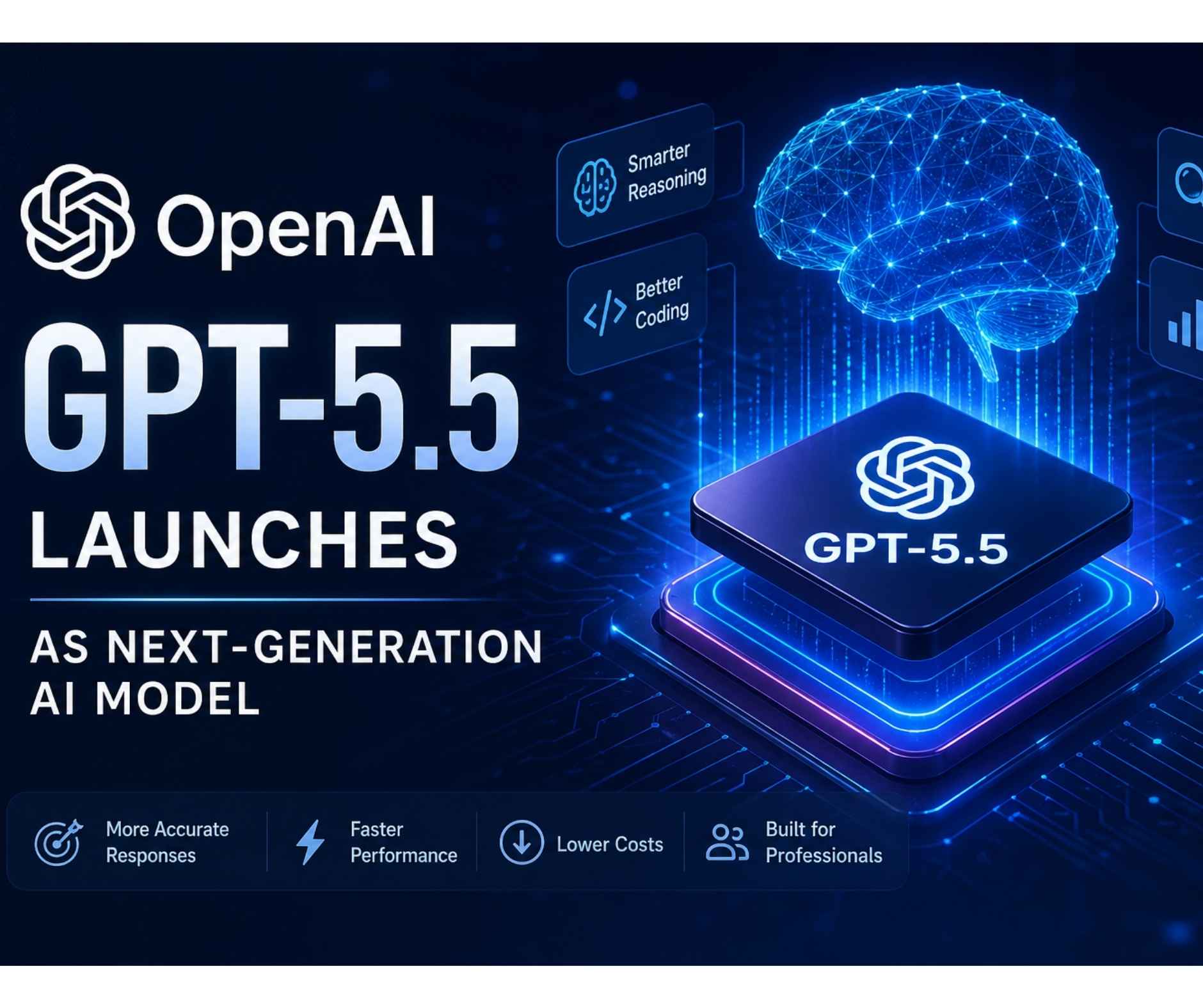
OpenAI has officially introduced GPT-5.5, its newest artificial intelligence model designed to deliver stronger real-world performance across coding, research, automation, and business workflows. The company describes the release as a major step forward in practical AI use, shifting beyond chatbot conversations toward systems that can actively help users complete meaningful work.
The launch of OpenAI GPT-5.5 comes at a time when competition in the AI market is accelerating rapidly, with major technology firms racing to offer smarter, faster, and more reliable models for both consumers and enterprise users.
OpenAI GPT-5.5 Built for Work, Not Just Chat
While earlier AI systems were mainly known for answering prompts or generating text, OpenAI GPT-5.5 has been developed with productivity in mind. According to OpenAI, the model is better at understanding user goals, planning tasks, and managing more complex requests with less step-by-step guidance.
Instead of needing multiple prompts to finish a task, users can reportedly provide one broad instruction and allow the model to organize the process. This makes GPT-5.5 more useful for professionals who need speed and efficiency in daily operations.
Common use cases include writing and fixing code, generating business reports, building spreadsheets, conducting online research, summarizing documents, managing repetitive workflows, and creating presentations and planning materials.
This broader utility positions GPT-5.5 as an AI assistant for serious work rather than casual entertainment.
Major Improvements in Coding
One of the strongest areas of improvement in OpenAI GPT-5.5 is software development. OpenAI says the model can write cleaner code, debug errors faster, and understand larger codebases more effectively than previous versions.
This is especially valuable for startups, developers, and engineering teams looking to reduce development time. AI coding tools have already transformed software workflows, and GPT-5.5 appears aimed directly at expanding that market.
Industry experts believe coding-focused AI systems could become one of the highest-value use cases in the next few years, helping companies ship products faster while reducing technical bottlenecks.
Better Research and Knowledge Work
OpenAI GPT-5.5 also introduces stronger performance in research-related tasks. Users can ask the model to gather information, compare sources, summarize findings, and convert raw data into actionable insights.
For analysts, marketers, students, consultants, and executives, this can significantly reduce time spent on manual information gathering.
The model is also better suited for handling document-heavy tasks such as reviewing contracts, organizing notes, or producing structured summaries from lengthy reports.
As businesses increasingly depend on data-driven decisions, these improvements could make GPT-5.5 highly attractive across multiple industries.
Faster Performance With Lower Costs
A key challenge with advanced AI models is balancing intelligence with speed. Larger models often become slower and more expensive to run. OpenAI says GPT-5.5 addresses this by offering stronger performance while maintaining fast response times.
The company also claims the model uses fewer tokens to complete tasks, improving efficiency for API users and enterprise customers managing high-volume workloads.
That matters because businesses are looking for AI solutions that not only perform well but also provide measurable return on investment.
Rising Enterprise Demand
The launch reflects growing demand for AI systems that can support real workplace needs. Many organizations now use AI tools for internal reporting, customer service automation, marketing assistance, workflow optimization, data processing, software engineering, and decision support systems.
Instead of replacing employees outright, many companies are deploying AI to increase productivity and allow teams to focus on higher-value tasks. OpenAI GPT-5.5 appears designed specifically for this trend.
Safety and Responsible Deployment
As AI becomes more capable, safety remains a central issue. OpenAI says GPT-5.5 launched with stronger safeguards, including misuse detection systems, cybersecurity testing, and tighter controls around sensitive requests.
Technology regulators and governments worldwide continue to monitor the rapid rise of advanced AI systems. Responsible deployment is now considered just as important as innovation.
By emphasizing safety alongside performance, OpenAI is signaling that trust will be critical in enterprise adoption.
Availability and Access
OpenAI GPT-5.5 is rolling out to ChatGPT Plus, Pro, Business, and Enterprise subscribers. API access is also being introduced, allowing developers and companies to integrate the model directly into software products, websites, and internal tools.
This wider rollout could quickly expand GPT-5.5’s reach across industries ranging from finance and healthcare to retail and education.
Industry Impact
The introduction of OpenAI GPT-5.5 highlights a major shift in the AI market. The focus is no longer only on conversation quality or novelty features. Businesses now want AI systems that save time, cut costs, and complete work accurately.
That shift may define the next stage of the AI economy. Companies that successfully integrate tools like GPT-5.5 into daily operations could gain a competitive advantage through faster execution and smarter decision-making.
Conclusion
OpenAI GPT-5.5 is more than another model update. It represents a strategic move toward AI that works alongside people in meaningful ways.
With stronger coding, smarter research, improved automation, and faster performance, GPT-5.5 could become one of the most influential productivity-focused AI launches of 2026.
For professionals and businesses alike, the future of AI may now be less about asking questions and more about getting results.
Get fresh perspectives on AI, startups, and business success at Welp Magazine.