Key Facts at a Glance
- Samsung Q1 2026 operating profit: 57.2 trillion won, up more than 8x year-on-year
- Samsung Q1 2026 revenue: 133.9 trillion won, a record high
- Samsung full-year 2025 operating profit: 43.6 trillion won, already surpassed by Q1 2026 alone
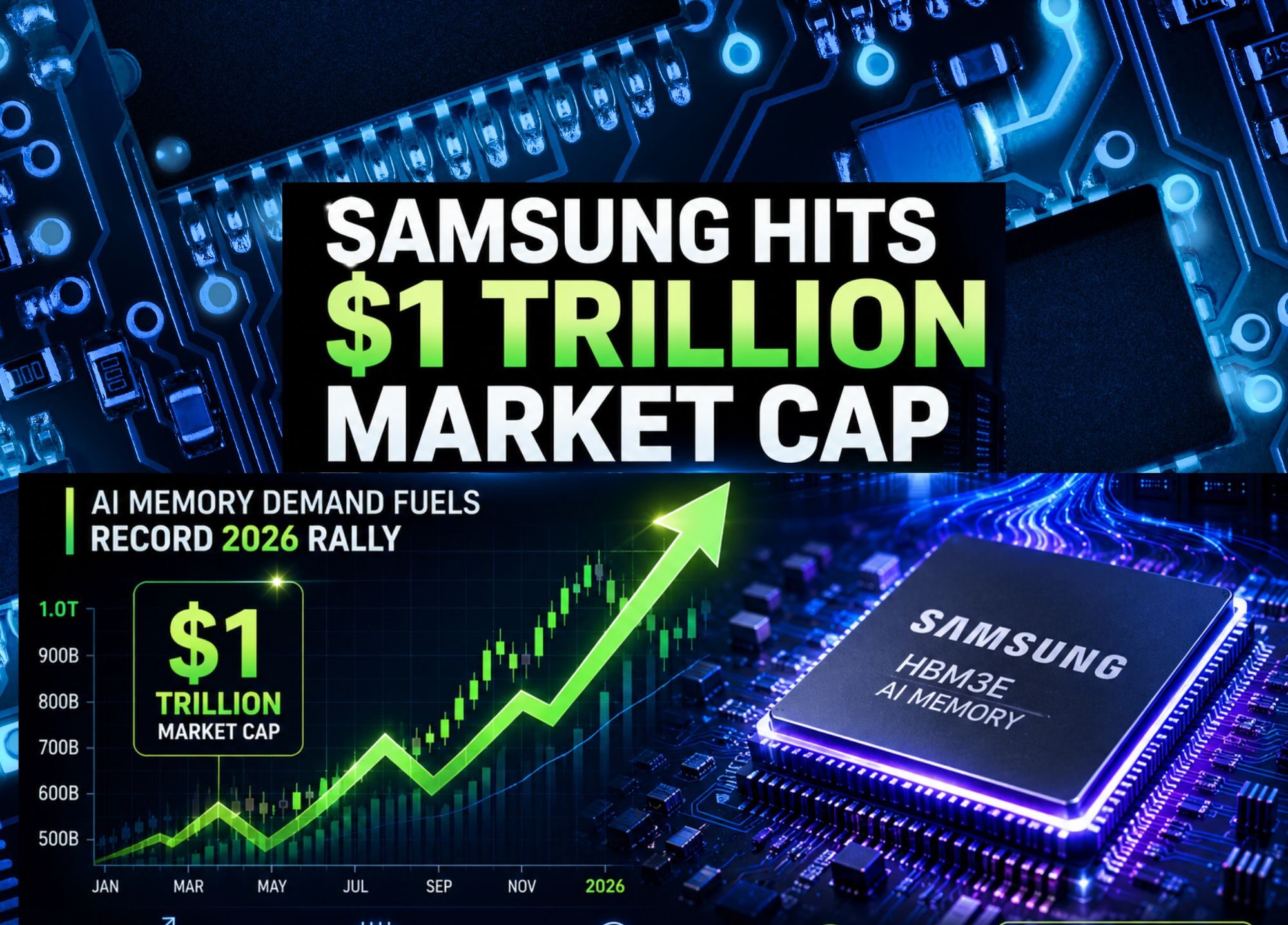
- Samsung market cap milestone: $1 trillion, first crossed February 26, 2026
- Samsung HBM market share: approximately 25%
- SK Hynix HBM market share: approximately 55%
- Kospi index: crossed 7,000 for the first time on May 6, 2026
- HBM4 production: Samsung began mass production and shipping as of February 2026
Samsung Electronics shares surged more than 15% on Wednesday, pushing the chip giant past the $1 trillion market cap milestone and setting the company on course for its largest single-day gain on record. The move cemented Samsung’s place as only the second Asian company to reach the $1 trillion valuation mark, after Taiwan’s TSMC, having first crossed the threshold on February 26, 2026, according to FactSet data.
Quick Answer: Samsung’s share price surged more than 15% on May 6, 2026, driven by record Q1 2026 earnings, an AI-fuelled memory chip shortage, and reports of exploratory chip supply talks between Apple, Samsung, and Intel.
What Drove Samsung’s $1 Trillion Valuation?
The rally did not come out of nowhere. Samsung had already been building momentum heading into this week, and Wednesday’s surge was the culmination of several converging factors that gave investors strong reason to pile back into the stock.
The most immediate catalyst was Samsung’s record first-quarter 2026 earnings report, released the previous week. Operating profit surged more than eightfold year-on-year to 57.2 trillion won. Revenue climbed to a record 133.9 trillion Korean won. To put that into perspective, Samsung’s Q1 2026 operating profit alone exceeded its entire full-year 2025 profit of 43.6 trillion won. That is not incremental growth. That is a structural shift in the business driven almost entirely by the AI boom.
The second major catalyst was a Bloomberg report that Apple has held exploratory talks with both Samsung and Intel about producing chips for Apple devices in the United States. If confirmed, that would represent a significant diversification away from TSMC, which has long been Apple’s primary chip supplier. The prospect of Samsung landing a slice of Apple’s production volume sent an additional signal to the market about the company’s growing strategic importance in the global semiconductor supply chain.
The AI Memory Shortage Powering the Rally
At the core of Samsung’s outperformance is a simple supply and demand imbalance playing out across the global memory chip market.
Artificial intelligence infrastructure, from large language model training to real-time inference in data centres, is extraordinarily memory-hungry. AI workloads require both high bandwidth to move data quickly between processors and substantial storage capacity to hold the vast datasets and model weights involved. That demand is landing squarely on DRAM and NAND chip makers, and it is not slowing down.
DRAM chips are fast, volatile memory chips that temporarily store data while processors are actively using it. NAND chips are slower, non-volatile storage chips that retain data when devices are powered off. Both categories are currently in short supply, and both are core to Samsung’s product portfolio.
Morningstar technology equity analyst Yu Jing Jie described the current environment as a tremendous shortage in DRAM and NAND memory chips due to torrid AI demand. The situation is compounded by the fact that new semiconductor manufacturing capacity typically takes two to three years to come online. Even as chipmakers race to expand production, meaningful supply relief is unlikely before 2027 at the earliest. That extended timeline is directly fuelling investor expectations for sustained earnings growth and higher margins across the near term.
What Is HBM4 and Why Does It Matter?
High-bandwidth memory, or HBM, sits at the cutting edge of this AI-driven demand wave. Unlike standard DRAM, HBM chips are stacked vertically and connected via a high-speed interface, allowing them to move data far faster than conventional memory. That makes them essential for AI accelerators, including Nvidia’s graphics processing units that power most of today’s AI infrastructure.
In February 2026, Samsung announced it had become the world’s first company to begin mass production of HBM4 chips, with deliveries already underway to undisclosed customers. HBM4 is the sixth and latest generation of high-bandwidth memory technology and is expected to play a central role in Nvidia’s upcoming Vera Rubin AI architecture, which is designed to power the next wave of advanced AI workloads in data centres.
Rolf Bulk, head of semiconductor and infrastructure at The Futurum Group, noted that customer feedback on Samsung’s latest HBM4 products has been positive. That matters because Samsung has been playing catch-up in this space. SK Hynix moved faster in earlier HBM generations and built a dominant market position as a result. Samsung’s ability to close that gap with HBM4 is being closely watched by the industry.
Samsung vs SK Hynix: Where Does the HBM Race Stand?
SK Hynix currently leads the global HBM market with an estimated 55% share. Samsung holds roughly 25%. That is a significant gap, and it has weighed on Samsung’s positioning in the AI memory segment for the past year.
However, analysts are becoming less focused on that gap for a specific reason: conventional DRAM profitability has recently overtaken HBM margins. That means Samsung’s large-scale standard DRAM business is generating strong returns even as it works to close the HBM technology gap. The company does not need to win the HBM race outright to benefit enormously from the current memory supercycle.
SK Hynix shares also jumped more than 10% on Wednesday, further confirming that the investment thesis is sector-wide rather than company-specific. The surge in both stocks helped push South Korea’s benchmark Kospi index more than 5% higher, crossing 7,000 for the first time in the index’s history.
Is the AI Memory Boom Sustainable?
The short answer is yes, at least through the near and medium term.
Rolf Bulk of The Futurum Group stated that current high memory prices and strong earnings for Samsung and its peers are likely to remain supported for some time, even accounting for new factory ramp-ups expected across the industry over the next several years. The structural driver is AI infrastructure buildout, which is not a temporary trend. Hyperscalers, cloud providers, and enterprise AI adopters are all in the early stages of multi-year capital expenditure cycles, and memory chips are foundational to every layer of that buildout.
That said, the memory industry is historically cyclical. Capacity will eventually catch up to demand. When it does, pricing pressure typically follows. The current question for investors is not whether that correction will come, but how long the current upcycle will last and how much Samsung and its peers can bank in the meantime.
Stay ahead of the biggest stories in tech.
Read more at Welp Magazine