Apple is reportedly preparing one of its most radical personal computing experiments: a screenless, AI-powered wearable often referred to in leaks as the Apple AI Pin. While the company has not officially announced the product, multiple industry indicators suggest Apple is exploring a future of ambient, voice-driven interaction that could reshape how we use devices. Instead of taps and swipes on a glass screen, this wearable aims to respond to voice, context, and real-world cues.
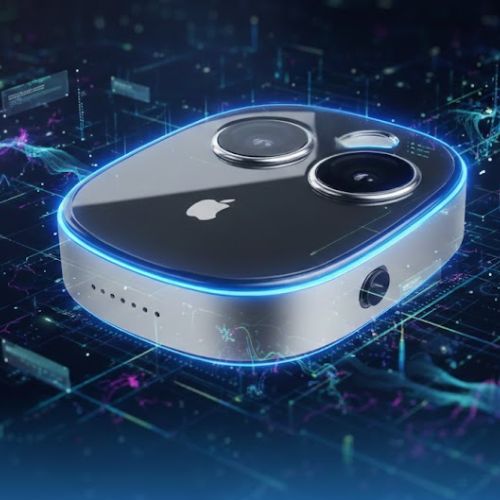
Unlike the iPhone or Apple Watch, the Apple AI Pin would entirely remove the screen. Early descriptions paint it as a compact device about the size of an AirTag that clips to clothing. Instead of pulling out a phone, users might simply speak asking questions, setting reminders, capturing notes, or identifying objects — and receive responses through audio or connected devices like AirPods and Apple Watch. This approach hints at a future where digital assistance feels ambient and context-aware rather than deliberate and screen-dependent.
How the Apple AI Pin Is Expected to Work
The Apple AI Pin is rumored to house dual cameras, microphones, a speaker, and a physical interaction button, but no display. Instead of looking at a screen, users would interact through speech, sounds, and subtle haptics. Apple’s Neural Engine may handle significant on-device processing to protect privacy, with cloud support for heavier tasks. This aligns with Apple’s traditional focus on user privacy and secure data handling.
More importantly, the Apple AI Pin is expected to work seamlessly with Apple’s ecosystem iPhone, Apple Watch, AirPods, Mac, and iPad—using Continuity features that allow conversations or tasks to move between devices without repeated commands. For example, a query initiated on the AI Pin could show detailed results on an iPhone screen or Apple Watch if visual feedback is needed.
Why Apple’s Approach Matters
What sets Apple’s vision apart from past wearable experiments is integration. Apple already connects billions of daily interactions across its ecosystem, so placing a new AI interface within that web could feel natural rather than disruptive. Rather than trying to replace the iPhone immediately, the AI Pin would act as an “intelligent layer” that makes technology feel smarter and less intrusive.
This does not mean the iPhone would disappear overnight. Instead, the Apple AI Pin may signal the start of a multi-year evolution in how people interact with technology shifting emphasis from screens to voice and context.
Lessons From the Humane AI Pin
The concept of an AI-first wearable is not entirely new. In 2024, a startup named Humane attempted a similar idea with its own AI Pin a wearable device powered by artificial intelligence and sold online, including via Amazon listings such as Humane AI Pin: Revolution Healthcare (Product B0D12Y41SX). While the Humane AI Pin was initially marketed as an innovative, screenless assistant capable of voice queries, translation, and even laser-projected interfaces, its real-world performance fell short of expectations.
Humane’s version featured a laser ink display that projected text and graphics onto a user’s hand, and it ran on a Qualcomm Snapdragon-based system with a camera, microphone, and sensors. However, reviews noted that it struggled with limited practical utility compared with smartphones, laggy performance, and short battery life. Despite strong early buzz, the Humane AI Pin failed to gain traction commercially. Sales were lower than expected, returns reportedly outpaced purchases at one point, and the device ultimately ceased functioning entirely after less than a year on the market when its backend services were shut down.
The Humane AI Pin’s short lifespan highlights how difficult it is to build truly practical, standalone AI wearables. It struggled primarily because it lacked deep ecosystem integration, had high ongoing costs, and delivered limited utility compared with existing devices. Future products, including the rumored Apple AI Pin, will need to learn from these early missteps.
Practical Scenarios for a Screenless AI Wearable
If Apple successfully builds its AI Pin with strong ecosystem support, everyday use cases could include:
- Hands-free information queries while commuting, cooking, or walking
- Voice-activated reminders, notes, and quick tasks
- Context-aware suggestions based on location, calendar, and routine
- Discreet alerts during workouts or meetings
- Seamless transitions of tasks from voice queries to visual screens when needed
However, success depends on how naturally the device fits into users’ lives — its comfort, reliability, social acceptability, and ability to genuinely reduce friction rather than add complexity.
Pros and Challenges of Screenless AI Wearables
Advantages:
- Effortless voice interaction without screens
- Personalized, context-aware assistance
- Tight integration with existing Apple hardware and services
- On-device processing for enhanced privacy
Challenges:
- Battery life constraints in a compact form
- Limited input precision without screens
- Social acceptance of visible wearables with cameras
- Reliance on robust ecosystem integration to feel useful
The Future of Personal Technology
The Apple AI Pin reflects a broader industry shift toward ambient computing technology that anticipates needs and assists quietly in the background rather than demanding constant attention. Whether Apple’s version succeeds where others have struggled will depend on execution, ecosystem strength, and real-world utility. But it reinforces one central idea: the next era of personal technology may be defined less by screens and more by intelligent interactions that feel natural and unobtrusive.
For more deep dives into the technology shaping our world, keep reading Welp Magazine, your source for the latest in tech, startups, and innovation.
Frequently Asked Questions
What is the Apple AI Pin?
The Apple AI Pin is a rumored screenless wearable designed to provide hands-free access to Apple AI features using voice, cameras, and contextual awareness.
Does the Apple AI Pin replace the iPhone?
No. The Apple AI Pin is expected to work as a companion device, relying on the iPhone and other Apple products for extended functionality.
How does the Apple AI Pin handle privacy?
Apple is expected to emphasize on-device processing, allowing the pin to analyze audio and visual input locally without constantly sending raw data to the cloud.
Is the Apple AI Pin always listening or recording?
The device is designed to activate only during intentional interactions, supported by privacy controls similar to other Apple devices.
Who is the Apple AI Pin designed for?
The pin is aimed at users deeply invested in the Apple ecosystem who want hands-free, low-friction access to digital assistance throughout the day.