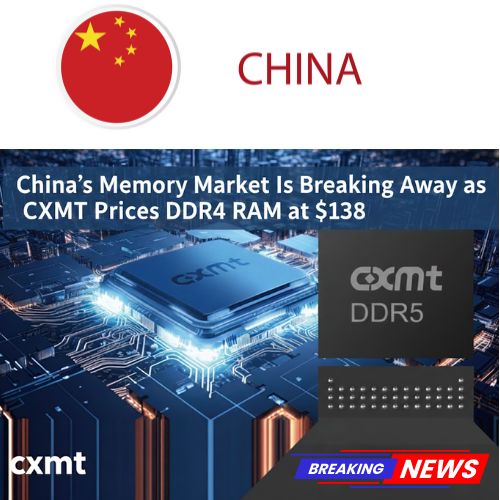
The China memory market is entering a new phase of independence, and the signal is subtle but powerful. A 32GB CXMT DDR4 RAM module has appeared in China’s domestic retail market at around $138, even as global DRAM prices continue to climb under pressure from AI and data center demand.
This pricing move is not accidental. It reflects a deliberate shift in how Chinese memory manufacturers are positioning themselves as global supply chains fracture and AI reshapes semiconductor priorities.
CXMT RAM Pricing in Context
On the surface, $138 may look like a discount. In reality, it sits squarely within today’s global pricing band once you factor in condition, use case, and market segmentation.
Unlike speculative headlines, real-world pricing data from secondary markets tells a more grounded story.
32GB DDR4 RAM Price Comparison (Global vs China)
| Memory Type | Market | Price Range (USD) | Notes |
|---|---|---|---|
| CXMT 32GB DDR4 (Non-ECC) | China Domestic Retail | ~$138 | New, consumer-grade, stable supply |
| DDR4-3200 ECC RDIMM | Global Used Market | $200–$225 | Server-grade, high demand |
| DDR4-2400 ECC RDIMM (Used) | Secondary Market | ~$100–$120 | Bulk sales, decommissioned servers |
| DDR4-2133 ECC RDIMM (Used) | Secondary Market | ~$120 | Older generation |
| New Branded Consumer DDR4 (32GB) | Global Retail | $150–$180 | Pricing volatile due to supply shifts |
This comparison makes one thing clear: CXMT DDR4 RAM pricing is disciplined, not aggressive. It undercuts premium ECC memory while staying above distressed used inventory.
Why AI Demand Is Distorting Global DRAM Prices
The global DRAM industry is no longer driven by consumer PCs. It is being reshaped by:
- AI accelerators
- Hyperscale data centers
- Server-grade memory demand
Major suppliers are prioritizing HBM and server DRAM, pulling capacity away from consumer DDR4. This has tightened supply across international markets and pushed prices higher, even for legacy memory standards.
As a result, DDR4 RAM prices 2026 forecasts continue to trend upward despite expectations of increased server decommissioning.
China DRAM Expansion Changes the Equation
China is responding with production, not price wars.
- CXMT DRAM production is scaling through new fabs
- YMTC memory fabs continue expanding despite sanctions
- China is targeting domestic HBM production by 2026
- CXMT is preparing a $4.2 billion IPO to fund capacity growth
This expansion allows China to decouple domestic memory pricing from global volatility. The $138 price reflects confidence in supply continuity rather than short-term discounting.
ECC vs Non-ECC RAM: Why the Difference Matters
A major reason global prices appear higher is the inflation of ECC RAM pricing.
ECC memory is essential for servers and workstations, making it scarce and expensive in an AI-driven market. Most Reddit and eBay listings reflect used ECC server RAM, not consumer-grade modules.
CXMT’s focus on non-ECC DDR4 RAM avoids that pressure entirely. It satisfies mainstream demand without competing directly with enterprise SKUs dominated by Samsung, SK hynix, and Micron.
This positioning is intentional and strategically clean.
A Structural Split in the Memory Market
What we are seeing is a structural split in the global memory supply chain.
- The global market is optimized for margin, AI, and hyperscalers
- The China domestic memory market is optimized for availability, predictability, and resilience
CXMT DDR4 RAM acts as a stabilizer inside China’s tech ecosystem, shielding OEMs and device makers from global DRAM shocks.
This is semiconductor self-reliance in execution, not theory.
The $138 CXMT DDR4 RAM price is not about being cheaper. It is about being in control.
By expanding capacity, aligning pricing with real market value, and insulating domestic supply from AI-driven chaos, Chinese memory manufacturers are quietly reshaping how memory works inside their borders.
In a world where memory is becoming strategic infrastructure, not a commodity, China is no longer reacting to the market.
It is designing its own.