A New Era in Quantum Computing
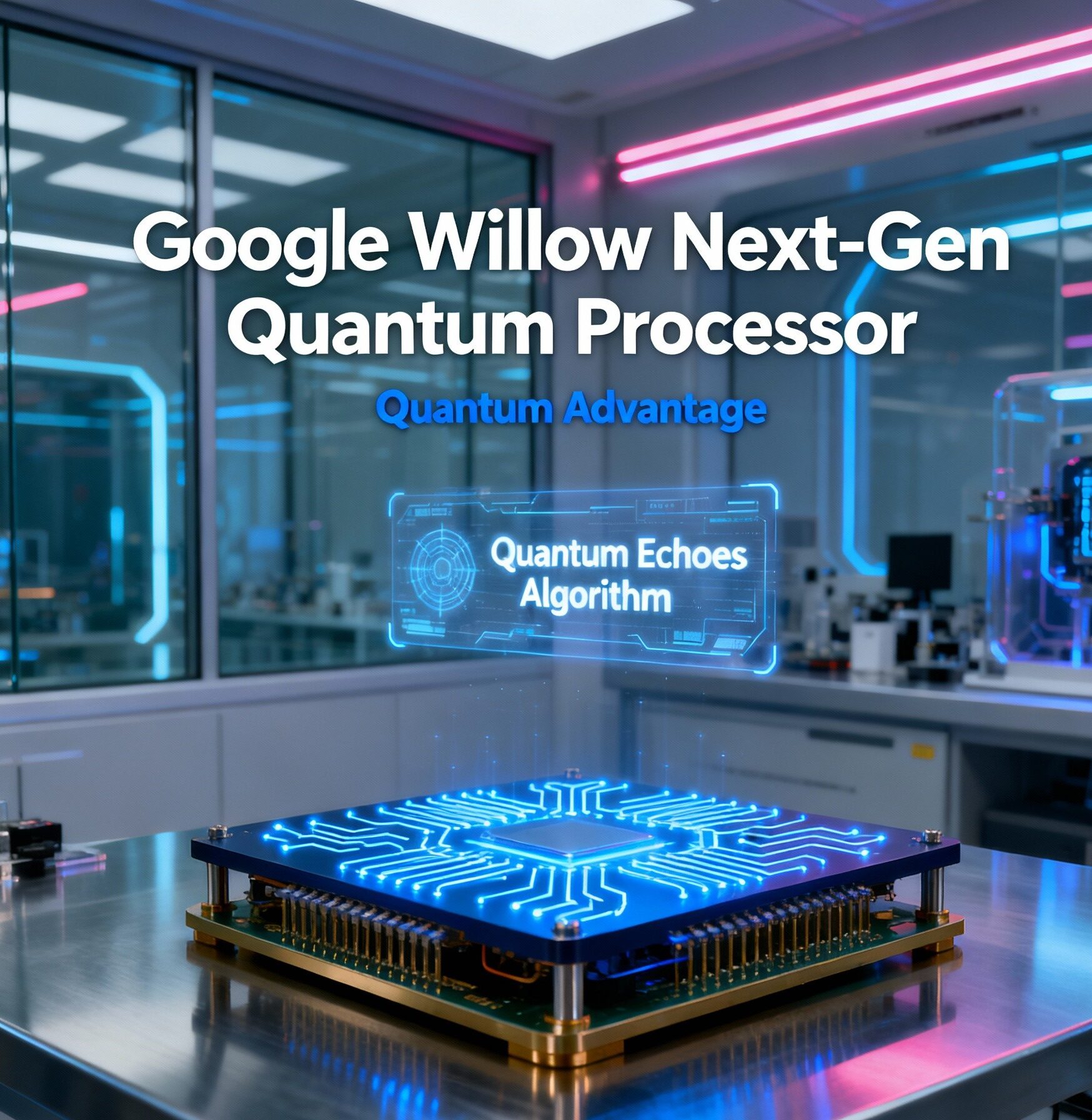
Silicon Valley, October 27, 2025 — Google has officially announced the Google Quantum Computing Breakthrough 2025, unveiling its new Willow chip, a next-generation quantum processor that achieved verifiable quantum advantage. Paired with Google’s Quantum Echoes algorithm, this milestone marks a 13,000× performance leap over the world’s most advanced classical supercomputers.
The breakthrough represents a defining moment in Quantum Computing, proving that quantum processors can outperform traditional systems in real-world, verifiable experiments.
Inside the Willow Chip: Where Science Meets Scale
The Willow chip is designed with higher coherence qubits and precise cryogenic controls, pushing quantum reliability closer to practical use. Using the Quantum Echoes algorithm, Google researchers were able to reproduce consistent and measurable outcomes—a task once considered impossible to verify in quantum systems.
Unlike previous experiments that faced reproducibility issues, Google’s Willow test allows classical verification of quantum behavior. That means scientists can finally trust the data output from quantum machines, a crucial step toward scalable applications.
“This is not just a faster machine,” said Hartmut Neven, head of Google Quantum AI. “It’s a verifiable one. Willow is a proof of trust in the quantum age.”
Why the Google Quantum Computing Breakthrough 2025 Matters
The implications of the Google Quantum Computing Breakthrough 2025 reach beyond research labs. Verified Quantum Computing capability could reshape industries that rely on complex modeling and data simulation:
- Pharmaceuticals: Simulating molecular interactions for faster drug discovery.
- Materials Science: Designing superconductors and battery compounds in hours, not years.
- Finance: Performing quantum-level risk simulations and portfolio optimization.
- Energy: Running detailed quantum models of climate systems for renewable strategies.
This means a decade of theoretical quantum advantage has finally translated into practical, measurable use cases.
A Competitive Edge in the Global Quantum Race
Following Google’s announcement, Alphabet’s market value surged as investors recognized the commercial potential of Quantum Computing. The company now leads the race against IBM, Microsoft, and China’s fast-growing quantum sector, which has also made breakthroughs in biomedical and photonic quantum systems this year.
China’s National Quantum Lab in Hefei recently unveiled a prototype quantum backpack computer, signaling fierce competition in portable quantum tech. Yet, Google’s verifiable approach through the Willow chip gives it an edge in proving reliability—a core metric for enterprise applications.
The Technology and Codes Behind the Breakthrough
At the core of Willow’s success lies its innovative qubit control and software stack, which uses Google’s open-source Cirq platform. The Quantum Echoes algorithm, meanwhile, allows repeatable signal measurements—“echoes”—to confirm results without destroying quantum information.
This design solves one of the greatest challenges in Quantum Computing: error correction. By achieving stability without full-scale logical qubits, Google has created a foundation for scalable, fault-tolerant computing.
Next Steps: From Research to Real-World Application
While this advance marks a major step, Google emphasizes that Quantum Computing is still in its experimental stage. The next goal is building logical qubits—error-corrected units that maintain data stability for extended computation cycles. Once achieved, industries could integrate quantum APIs directly into cloud services like Google Cloud, revolutionizing enterprise data processing.
For now, the Google Quantum Computing Breakthrough 2025 proves that quantum systems are no longer theoretical marvels—they’re measurable, repeatable, and commercially significant.
Global Reactions and Verification
Independent reports from Reuters, MIT Technology Review, and The Guardian have confirmed the reproducibility of Google’s data, marking the first time a quantum claim has received broad scientific validation.
“Google’s approach isn’t just about speed—it’s about certainty,” said MIT physicist Dr. Lena Wirth. “Verification is the missing link in the quantum puzzle, and Willow just solved it.”
Conclusion: The Start of a Quantum Age
The Willow chip positions Google as the new standard-bearer for verified Quantum Computing. By achieving reproducible quantum advantage, Google has redefined how the world measures computational power.
From AI to biomedicine, this is not just a leap for Google—it’s a leap for the future of computation itself.