Introduction
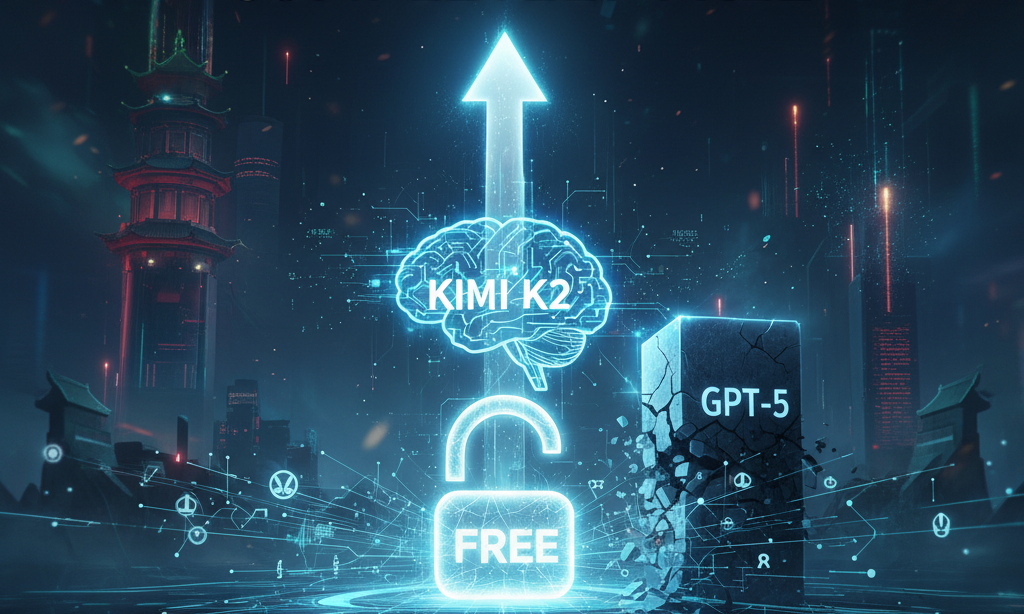
In a move that’s turning heads across the global AI industry, Kimi K2 Thinking, an open-source model from China, has reportedly surpassed GPT-5 and Claude 4.5 on some of the most challenging reasoning benchmarks. And here’s the kicker — it’s free to try. This isn’t just another large language model: it’s being hailed as a genuine agentic AI, designed to think, plan, and act with long-term logic and minimal human supervision.
Trend Analysis & Historical Context
Back in 2023, the “DeepSeek moment” marked China’s early foray into high-performing, open-source LLMs. But Kimi K2 Thinking takes that ambition to a whole new level. Where DeepSeek challenged assumptions, K2 Thinking is challenging business models: its open access and powerful architecture suggest a pivot from closed, paid AI toward truly democratized, high-performance reasoning agents.
How Kimi K2 Thinking Works
At its core, K2 Thinking is built to sustain 250–300 sequential tool calls — not for simple Q&A, but for deep, multi-step workflows. It can orchestrate APIs, integrate with external tools, plan research or coding processes, and execute with maintained coherence. That kind of agency is rare in consumer-facing AI today.
A key enabler: 256K token context window. It means K2 can ingest entire research papers, long-form code projects, or complex multi-document workflows and reason over them in one go. Insert a document, and it doesn’t lose context halfway through.
Another major innovation: native INT4 quantization. The model is trained to operate in low-bit mode, cutting inference latency and GPU memory usage dramatically — without a big drop in quality.
Current Developments & Comparison
Here’s a quick comparison of Kimi K2 Thinking, GPT-5, and Claude 4.5:
| Model | Primary Strength | Tool Chaining | Context Window | Efficiency (Quantization) | Access / Cost |
|---|---|---|---|---|---|
| Kimi K2 Thinking | Agentic reasoning & planning | 250–300 sequential calls | 256K tokens | Native INT4 | Open-source, free tier |
| GPT-5 / ChatGPT | General-purpose reasoning & chat | ~30–50 calls before drift | ~128K tokens | FP16 / mixed | Paid subscription |
| Claude 4.5 | Safety, alignment, text generation | 20–40 calls (agent flows) | ~64K–128K tokens | INT8 / mixed | Enterprise / paid access |
Micro-Analysis & Insight
- Why 300 Tool Calls Matter: Most LLMs degrade or lose coherent purpose after a dozen chained actions. K2 Thinking’s ability to maintain logic over hundreds is a huge step for autonomous AI workflows.
- Long-Context Edge: With 256K tokens, it’s ideal for research labs, corporate teams, or dev shops that need a “thinking partner,” not just a chatbot.
- Efficiency That Scales: INT4 mode isn’t just about speed — it reduces infrastructure cost, making high-performance AI accessible to smaller teams.
Future Outlook & Implications
If Kimi K2 Thinking proves stable and reliable in real-world use, it could shift the entire AI ecosystem. Startups and researchers might prefer open-source agents over locked-in, expensive proprietary LLMs. Over time, more data tools and orchestration APIs will likely be built on top of models like K2, pushing agentic AI into day-to-day enterprise and consumer workflows.
On the flip side, the growing power and autonomy of such models raise regulatory and safety questions: how do we govern AI that plans and acts? The next 6–12 months will likely be critical for standard-setting and developer adoption.
How to Try It
Kimi K2 Thinking is already accessible via the Moonshot AI platform, which offers both a free tier for experimentation and a low-cost pay-as-you-go API. For developers who want to build agentic workflows, it’s a powerful playground — and a strong argument for using open-source intelligence over expensive proprietary systems.
Kimi K2 Thinking isn’t just another LLM — it’s a leap into thinking AI. By combining deep reasoning, high-efficiency inference, and open access, it challenges the dominance of GPT-5 and Claude in a fundamental way. For anyone building next-gen AI systems — or simply curious about where intelligence is headed — this model is absolutely worth a close look
FAQS
1.What is Kimi K2 Thinking?
A powerful, open-source reasoning model capable of chaining hundreds of tool calls and long-context planning.
2.How does Kimi K2 Thinking compare to GPT-5?
It offers more sustained multi-step reasoning, larger context window, and a free or low-cost access path.
3.Is Kimi K2 Thinking really free?
Is Kimi K2 Thinking really free?
4.What can you use it for?
Research planning, coding projects, multi-stage automation, and oResearch planning, coding projects, multi-stage automation, and other workflows demanding agentic AI.her workflows demanding agentic AI.
5.Does it run efficiently?
Yes , thanks to native INT4 quantization, it’s optimized for low latency and memory usage.
Explore More Cutting-Edge AI Stories on Welp Magazine
Dive deeper into the world of open-source models, intelligent agents, and next-gen AI breakthroughs.
Read More on Welp Magazine