Table of Contents
What the Kimi K3 Open Weight Model Actually Is
Moonshot AI released Kimi K3 on July 16, and the headline number traveled faster than any explanation of it. At 2.8 trillion parameters, the Kimi K3 open weight model is the largest openly available AI model ever shipped, clearing the previous open weight record by a wide margin and landing in a size class no public model had reached before.
Full weights go public on July 27. Until then, K3 is reachable only through Moonshot’s apps and API. It is a mixture of experts model, meaning it does not run its full 2.8 trillion parameters for every request. Instead it splits itself into 896 specialized sections and activates just 16 of them per token, roughly 1.8 percent of the total.
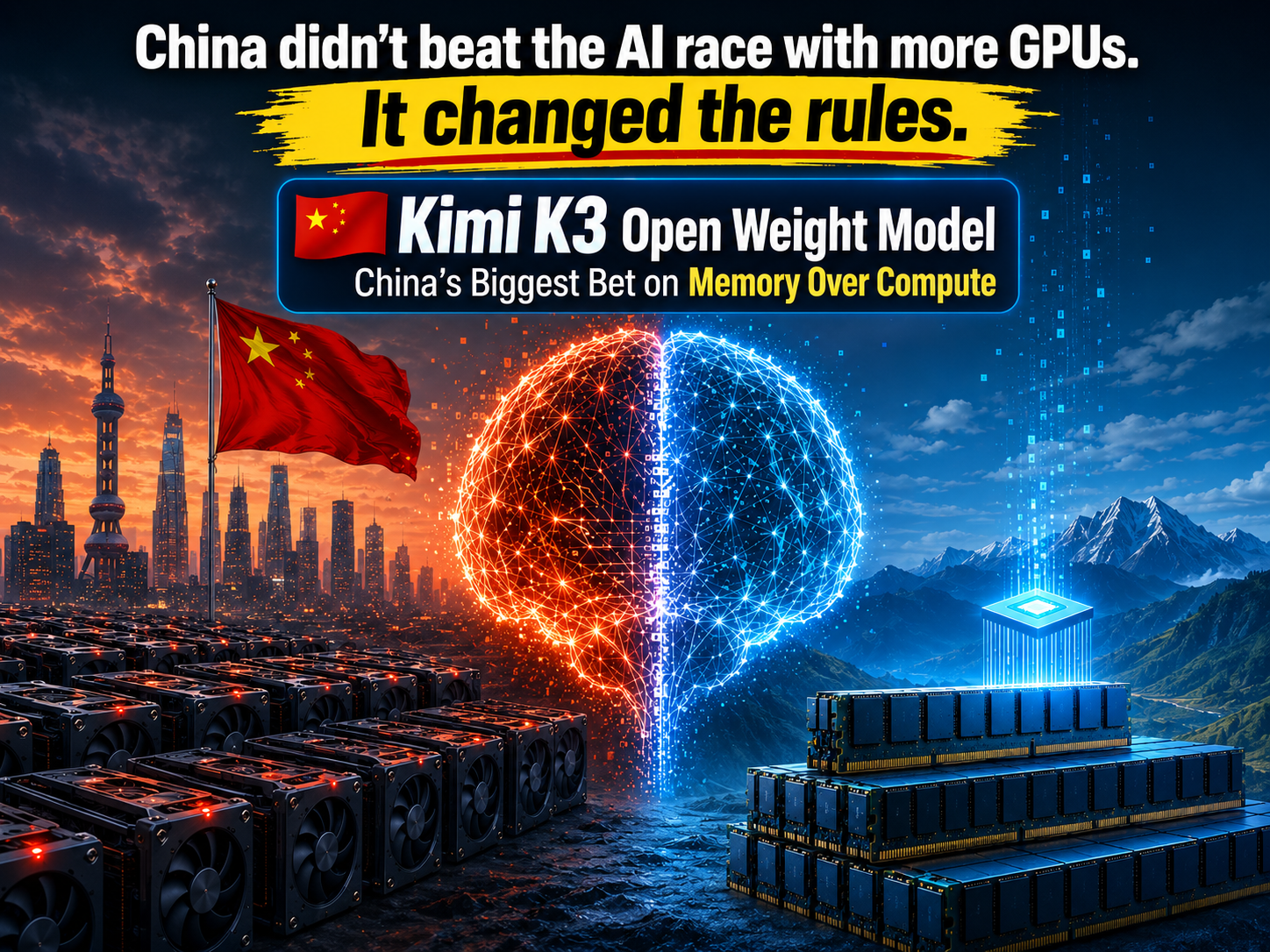
That detail matters more than the parameter count itself, because it explains what Moonshot actually built. This is not simply a bigger model. It is a model designed around a constraint that has nothing to do with raw processing power.
Trading Compute for Memory
Running the Kimi K3 open weight model costs two different things. Compute is how much calculation happens to produce each word. Memory is how much of the model has to sit loaded and instantly reachable the whole time it works. US export controls have restricted the training grade chips Chinese labs can access, so the pressure has mostly fallen on compute.
Mixture of experts already lowers the compute bill, since only a sliver of the model fires per token. But it does nothing for memory, because all 2.8 trillion parameters still have to be held ready in case they are the ones called next. Moonshot’s real engineering work went into shrinking that second number.
The company trained K3 at four bits of precision per parameter instead of the usual sixteen, a method called quantization aware training applied from the fine tuning stage onward. Independent analysis puts the resulting model at roughly 1.4TB, compared with 5.6TB at full precision. Moonshot also built a technique called Kimi Delta Attention to shrink the memory a model burns through when reading very long documents, and contributed the caching code behind it to the open source vLLM project.
Kimi K3 vs DeepSeek V4 Pro vs GLM-5.2
Three Chinese labs now sit at the top of the open weight leaderboard, and the comparison between them is not close to uniform. On the Artificial Analysis Intelligence Index, a neutral benchmark suite that scores every model the same way, the Kimi K3 open weight model posts roughly 57, GLM-5.2 scores about 51, and DeepSeek V4 Pro comes in near 44.
Pricing runs in the opposite direction. DeepSeek V4 Pro is the cost leader by a wide margin at 0.435 dollars per million input tokens and 0.87 dollars per million output tokens. GLM-5.2 sits in the middle. K3 is the most expensive of the three at 3 dollars input and 15 dollars output, dropping to 0.30 dollars on cached input.
License terms split the field too. DeepSeek V4 Pro and GLM-5.2 are already MIT licensed with weights live on Hugging Face today. Kimi K3 stays API only until its July 27 weight release, expected under a modified MIT license.
| Model | Total Parameters | Context Window | Input $/1M | Output $/1M | Weights Available |
|---|---|---|---|---|---|
| Kimi K3 | 2.8 trillion | 1 million tokens | $3.00 | $15.00 | July 27, 2026 |
| DeepSeek V4 Pro | 1.6 trillion | 1 million tokens | $0.44 | $0.87 | Available now |
| GLM-5.2 | 744 billion | 1 million tokens | $1.40 | $4.40 | Available now |
| Claude Fable 5 | Undisclosed, closed | Undisclosed | $10.00 | $50.00 | Closed model |
| GPT-5.6 Sol | Undisclosed, closed | Undisclosed | $5.00 | $30.00 | Closed model |
| Grok 4.5 | Undisclosed, closed | 500,000 tokens | $2.00 | $6.00 | Closed model |
How It Stacks Up Against Claude Fable 5 and GPT-5.6 Sol
Against the closed frontier labs, the Kimi K3 open weight model lands just below the top tier rather than at it. On the same Intelligence Index, K3 ranks third overall behind Claude Fable 5 and GPT-5.6 Sol, putting it in the same range as Opus 4.8 and GPT-5.5. Moonshot says as much itself, stating plainly that K3 still trails Fable 5 and Sol on overall performance.
The price gap tells a different story than the capability gap. Fable 5 costs 10 dollars input and 50 dollars output per million tokens, more than three times what K3 charges even before cache discounts. Sol is cheaper than Fable 5 but still runs well above K3 on output pricing. For teams weighing cost against a small capability gap, that math is the entire pitch behind open weight models this cycle.
Coding benchmarks favor K3 more clearly. Moonshot’s own testing has K3 beating GLM-5.2 on every shared benchmark by wide margins, including a 30.8 to 12.9 lead on Automation Bench and 42.0 to 13.0 on SWE Marathon. DeepSeek V4 Pro remains competitive in isolated coding tasks, posting 80.6 percent on SWE bench Verified in separate testing, a result tied with Gemini 3.1 Pro.
What It Means for Enterprises
The practical question for most businesses is not which model tops a leaderboard. It is whether a 2.8 trillion parameter model is deployable at all. Moonshot recommends serving the Kimi K3 open weight model across 64 or more accelerators wired together as a single pool, which is a data center commitment rather than something a mid sized team racks in a server room.
Even in its compressed four bit format, the model runs to roughly 1.4TB before accounting for the extra memory a long document conversation adds on top. Chip supply and memory production remain the binding constraint behind that math, and it explains why most enterprises evaluating K3 will end up renting capacity rather than owning it.
The tooling is not fully ready either. Kimi Delta Attention and the mixture of experts routing in K3 are new enough that standard open source serving software does not yet support them cleanly. Moonshot says it is working with inference partners to close that gap before the July 27 weight release, so teams planning a self hosted rollout should treat the announcement date and the usable date as two different milestones.
Claims That Are Verified, and Claims That Are Not
Some of what has circulated about the Kimi K3 open weight model is independently confirmed. Its rank on the Artificial Analysis Intelligence Index comes from a third party benchmark, not a Moonshot press release, and its win on the LMArena Frontend Code leaderboard reflects blind developer voting rather than a vendor claim.
Most other numbers are still first party. Moonshot’s own limitations section is unusually candid, warning that output quality can become unstable if a serving harness fails to pass back prior reasoning content, and that the model can act on ambiguous instructions in unexpected ways. Kimi K2 Thinking, the model K3 replaces, drew similar scrutiny when it first claimed to outperform GPT-5, and much of that record only firmed up after outside labs ran their own tests.
That gap will not close until the weights ship. No outside lab can fully verify a model it cannot download, which means every K3 benchmark published before July 27 carries an asterisk, however credible the source.
What is the Kimi K3 open weight model?
Kimi K3 is a 2.8 trillion parameter mixture of experts AI model released by Moonshot AI on July 16, 2026. It is the largest open weight model shipped to date, with full weights scheduled for public release on July 27.
How does Kimi K3 compare to DeepSeek V4 and GLM-5.2?
K3 scores highest of the three on the Artificial Analysis Intelligence Index, but it is also the most expensive to run and the only one of the three without publicly downloadable weights today. DeepSeek V4 Pro is the clear cost leader, and GLM-5.2 is the fastest and smallest of the group.
Can Kimi K3 be self hosted by a typical company?
Not easily. Moonshot recommends running it across 64 or more accelerators as a single pool, which puts local deployment out of reach for most organizations without dedicated data center capacity.
Why does Kimi K3 focus on memory instead of compute?
Export controls have limited the training grade chips available to Chinese AI labs, so Moonshot engineered K3 around techniques like four bit quantization and Kimi Delta Attention that reduce memory demands without needing more raw processing power.
Is Kimi K3 better than Claude Fable 5 or GPT-5.6 Sol?
Not on overall capability. Moonshot itself states that K3 trails both models. Its advantage is price, since it costs a fraction of what Fable 5 charges per million tokens while landing close behind on benchmark scores.
When will Kimi K3 weights be publicly available?
Moonshot has committed to releasing the full weights on July 27, 2026, expected under a modified MIT license.
Final Thoughts
The Kimi K3 open weight model is less a story about size than about where the real bottleneck sits. Moonshot did not out compute anyone. It re engineered a flagship model around the constraint it could not avoid, and the fact that a 2.8 trillion parameter system can be discussed in the same sentence as memory efficiency says as much about the state of chip export policy as it does about Moonshot’s engineering.
For more coverage on how open weight models, chip supply, and AI infrastructure spending are reshaping the industry, keep following Welp Magazine for daily breakdowns of the stories that matter.
Source: AI News