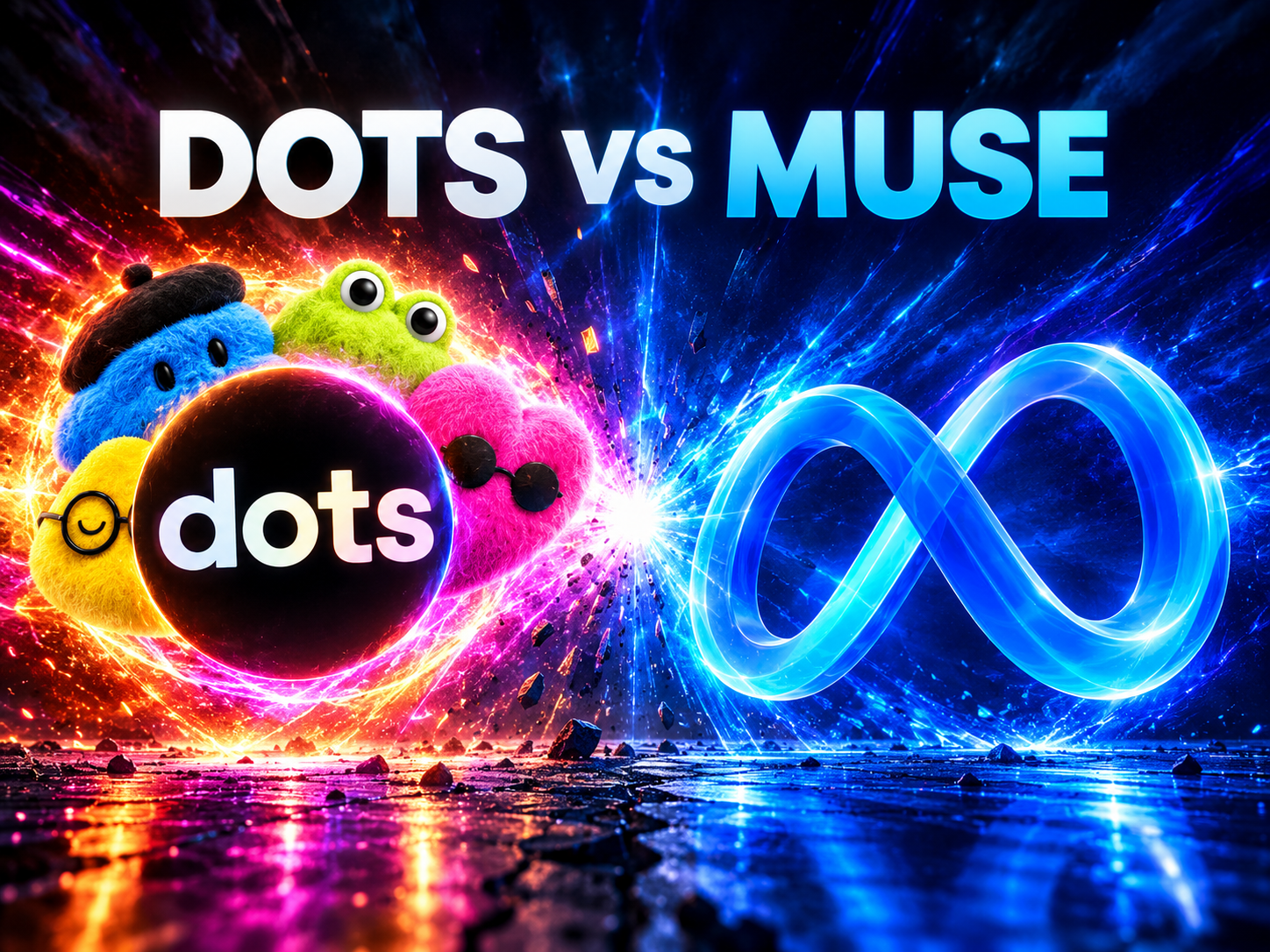
Two days after Meta bragged about Muse crossing 3.4 million downloads, OpenAI walked onto the DevDay 2026 stage and, with a straight face, introduced an AI agent named after a pear wearing glasses and a bow tie. Meet Dots: OpenAI’s always-on, always-weird answer to Meta’s biggest agentic bet yet. Somewhere in the chaos, the domain dot.com started redirecting to rival Grok Bot, live demos stalled on stage, and Sam Altman casually claimed OpenAI now has “an AI research intern.” Welcome to the AI agent wars.
Quick Facts: OpenAI Dots
- What it is: OpenAI’s new always-on AI agent, launched at DevDay on September 29, 2026
- Powered by: GPT-6 Astra, OpenAI’s flagship model
- Personality: Each dot has its own character and avatar (Alfred the yellow pear, Felipe the blue cloud)
- OpenAI Dots pricing: First dot free with Pro and Business Premium; new $500/month tier for heavy users
- The rival: Positioned directly against Meta’s Muse, launched three weeks earlier
What Are OpenAI’s Dots, Exactly?
Dots are OpenAI’s take on a fully independent AI coworker. Unlike ChatGPT or Codex, which wait for you to open an app and type something, a dot runs continuously in the background, on its own dedicated cloud computer, pursuing a goal you set once and then mostly leaving alone.
Each dot connects to more than 4,000 apps through OpenAI’s plugin ecosystem, and you can reach one through ChatGPT, Slack, Microsoft Teams, or a phone call, with text message support coming soon. According to TechCrunch’s coverage of the launch, one demo had a dot set loose monitoring customer feedback and shipping bug fixes on its own, while another reran a scientist’s data analysis every time new experimental results came in.
Meet Alfred and Felipe: Yes, Dots Have Personalities
This is the detail everyone is talking about, and it’s central to what makes the OpenAI agentic avatar concept so different from a typical background script. Rather than shipping a faceless background process, OpenAI gave dots actual characters. In the DevDay demos, Alfred showed up as a yellow pear wearing glasses and a bow tie, while Felipe appeared as a blue cloud in a beret. TechCrunch described the whole launch as OpenAI’s “bubbly agentic avatar,” and that’s putting it mildly.
It’s a strange choice for a product meant to handle serious, unattended work, but it’s also a smart one. An agent that quietly reruns your production deploys is unsettling. An agent named Felipe wearing a beret is, somehow, a lot easier to trust with the same job.
ChatGPT Space: Where Dots Actually Live
Dots don’t work alone. OpenAI paired the launch with ChatGPT Space, a new collaborative layer where employees, ChatGPT, Codex, and multiple dots can all work against the same shared context. Inside Space, teams build “pages,” a new kind of interactive document that can hold charts, images, checklists, and dashboards that update as the underlying work changes.
The pitch is straightforward: instead of an agent quietly doing something in isolation and reporting back with a wall of text, Space gives humans a live, visual surface to watch dots work, edit their output directly, and hand off follow-up tasks in the same place.
OpenAI Dots Pricing: Free, Until It’s $500 a Month
The entry point is generous. Your first dot is included at no extra cost with a ChatGPT Pro or Business Premium subscription, in eligible markets, which removes a lot of the friction Meta is still dealing with by charging $20 to $100 a month for Muse.
But OpenAI also introduced a new $500-a-month tier aimed squarely at power users and businesses, which unlocks the highest usage allowance and makes Codex run up to eight times faster. It’s a wide spread: free-with-subscription on one end, enterprise-grade pricing on the other, with not much detail yet on what sits in between.
Dots vs Muse: How the Two Actually Compare
| Feature | OpenAI Dots | Meta Muse |
|---|---|---|
| Launched | September 29, 2026 | September 8, 2026 |
| Underlying model | GPT-6 Astra | Muse Spark family |
| Personality | Named characters with avatars (Alfred, Felipe) | No public-facing persona |
| Where you reach it | ChatGPT, Slack, Teams, phone calls | Standalone Muse app, WhatsApp |
| App connections | 4,000+ apps via plugins | Native to Meta’s own apps |
| Entry price | Free with Pro/Business Premium | Free tier, then $20 or $100/month |
| Top-tier price | $500/month | $100/month |
The two products are chasing the same idea, an agent that works while you don’t watch it, but they’re built for different worlds. Muse leans on Meta’s social graph and consumer reach; Dots leans on OpenAI’s developer ecosystem and enterprise plugin network. If Muse is the agent for your personal errands, Dots is shaping up to be the agent for your actual job.
The Launch Had a Few Bumps
Not everything about DevDay went smoothly, and it’s worth saying so plainly. Live demos reportedly stalled on stage, and some ChatGPT users hit elevated error rates during the keynote itself, which is an awkward look for a product built entirely around reliability. Sam Altman’s claim that OpenAI now has “an AI research intern” arrived with no paper and no public evaluation to back it up.
And then there’s the detail that’s already becoming a running joke online: the domain dot.com, presumably meant to be a clean landing page for the new product, was found redirecting straight to competitor Grok Bot. According to Fortune’s reporting, nobody at OpenAI has explained that one yet.
Should You Actually Use a Dot?
If you’re already paying for ChatGPT Pro or Business Premium, trying your first dot costs nothing, which makes it an easy experiment for a well-defined, low-risk background task, like monitoring a feed or rerunning a routine analysis. The $500 tier is a much bigger commitment, and one that only makes sense once you know exactly what a dot is replacing on your team.
Compared with Meta Muse, Dots feel more built for work than for errands, which lines up with where each company is strongest. For a broader look at how fast this whole category is moving, see our coverage of the Meta Muse launch and xAI’s always-on Grok Bot, since all three companies are now racing toward the same always-on future from different angles.
Frequently Asked Questions
What are OpenAI’s Dots?
Dots are OpenAI’s new always-on AI agents, launched at DevDay on September 29, 2026. They run continuously on their own cloud computer, pursue a goal you set, and can be reached through ChatGPT, Slack, Teams, or phone calls.
How much do OpenAI Dots cost?
Your first dot is included free with a ChatGPT Pro or Business Premium subscription in eligible markets. OpenAI also offers a $500 per month tier for heavier use, which includes faster Codex performance.
How is OpenAI Dots different from Meta Muse?
Dots run on GPT-6 Astra and connect to more than 4,000 apps through OpenAI’s plugin ecosystem, reachable via ChatGPT, Slack, and Teams. Muse runs on Meta’s Spark models and is built around Meta’s own apps, reachable through WhatsApp and a standalone app.
What is ChatGPT Space?
ChatGPT Space is OpenAI’s new collaborative layer where employees, ChatGPT, Codex, and dots work against shared context, using interactive pages that can include charts, checklists, and dashboards.
Did OpenAI’s Dots launch go smoothly?
Not entirely. Live demos reportedly stalled during the keynote, some ChatGPT users saw elevated errors, and the domain dot.com was found redirecting to rival Grok Bot.
Curious which always-on agent wins the trust test first? Keep following Welp Magazine’s AI coverage as Dots, Muse, and Grok Bot all race for the same job: doing your work while you’re not looking.