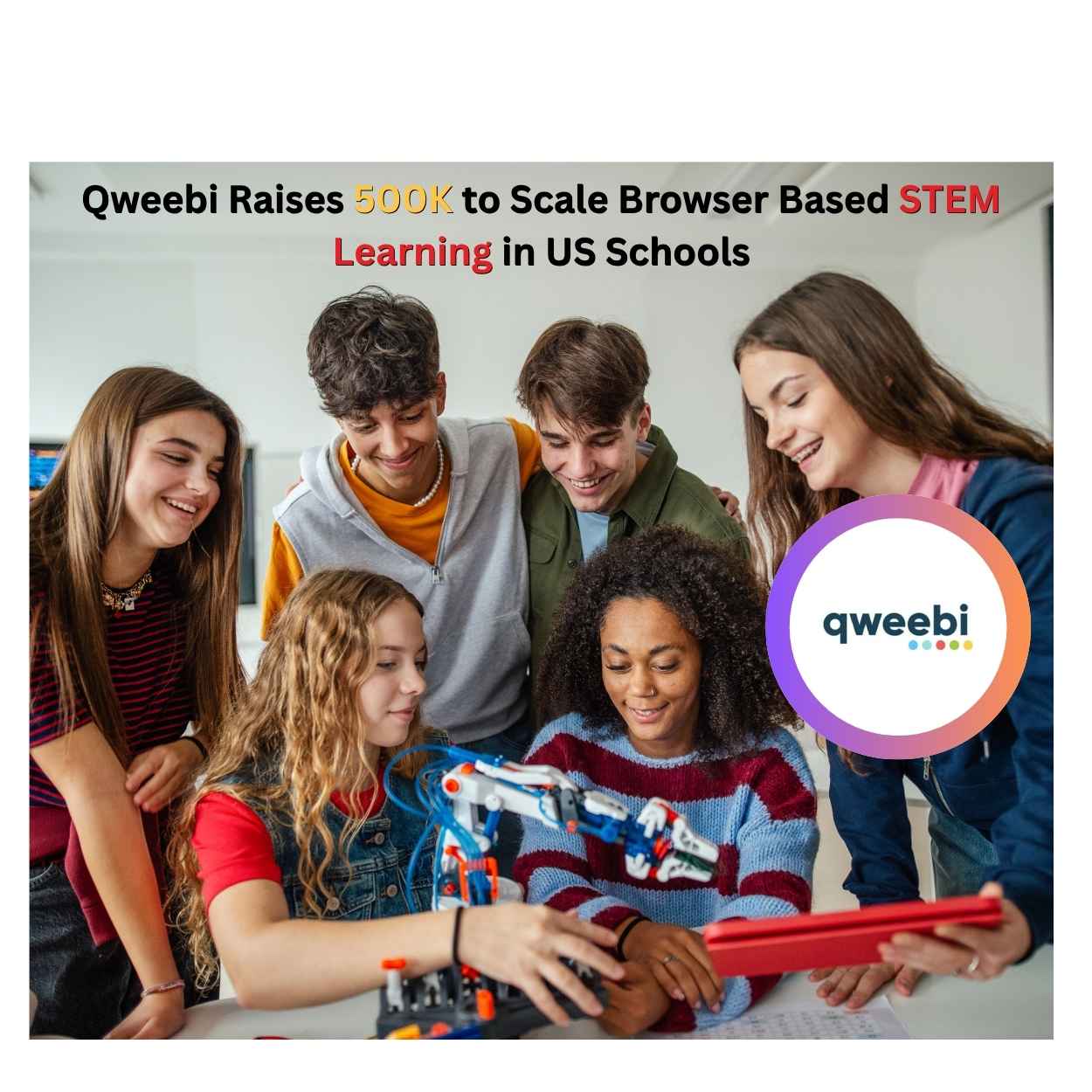
K-12 edtech startup Qweebi has raised $500,000 in a seed funding round led by Inflection Point Ventures, as it looks to expand its browser based STEM learning platform across school districts in the United States.
The round also saw participation from Jeroen Tas and Arpit Jain, adding strategic backing from experienced global operators in technology and education.
Platform Focused on Hands On STEM Learning
Qweebi operates in the K-12 education segment, offering a digital platform that enables schools to conduct engineering and robotics projects entirely through a web browser.
The platform eliminates the need for physical kits or lab infrastructure, allowing students to design, build, and test projects in a virtual environment. It also provides structured modules and lesson plans that help teachers run classroom activities with minimal preparation time.
CEO Vivek Seetharaman said the goal is to make hands on learning accessible to every student by removing cost and logistical barriers that often limit practical education in schools.
Strong Adoption Across the US Market
The company reports that more than 5,200 schools across all 50 US states have signed up to use the platform, reaching over 100,000 students.
Qweebi’s growth has been largely organic, driven by teacher adoption and classroom usage rather than heavy marketing spend. This indicates strong demand for scalable and easy to implement STEM learning solutions within the K-12 ecosystem.
Addressing Key Challenges in STEM Education
Schools have long faced challenges in delivering hands on STEM education due to high costs, limited infrastructure, and time constraints for teachers.
Qweebi’s browser based approach addresses these issues by removing the dependency on physical resources. Students can engage in practical learning experiences without requiring equipment, while teachers can focus on instruction rather than setup.
According to Mitesh Shah, the platform offers a scalable solution to a widespread problem, enabling schools to deliver engineering and robotics education without additional infrastructure investment.
Plans for Expansion and Product Development
The company plans to use the newly raised capital to further develop its platform and expand its presence across US school districts.
This includes improving product capabilities, enhancing user experience, and increasing adoption among educators and institutions.
Qweebi aims to strengthen its position within the growing digital STEM education market, where demand for practical, skills based learning continues to rise.
Growing Demand for Experiential Learning
The funding comes at a time when schools globally are shifting toward experiential and project based learning models.
Educators are increasingly prioritising real world skills and interactive learning experiences over traditional lecture based methods. Platforms that can deliver these experiences at scale are gaining traction.
Qweebi’s model aligns with this shift, offering a digital solution that combines accessibility with hands on engagement.
Market Outlook
As STEM education becomes a critical component of workforce readiness, startups that enable scalable and cost effective learning solutions are attracting investor interest.
Qweebi’s early traction and browser first approach position it well to expand both within the United States and in international markets where access to STEM infrastructure remains limited.
Conclusion
Qweebi’s $500,000 seed funding marks an important step in its growth journey as it works to make hands on STEM learning more accessible and scalable.
By removing infrastructure barriers and enabling practical education through a browser based platform, the company is addressing a key gap in the K-12 education system.
With increasing demand for experiential learning, Qweebi is well positioned to play a larger role in shaping how STEM education is delivered in the years ahead.