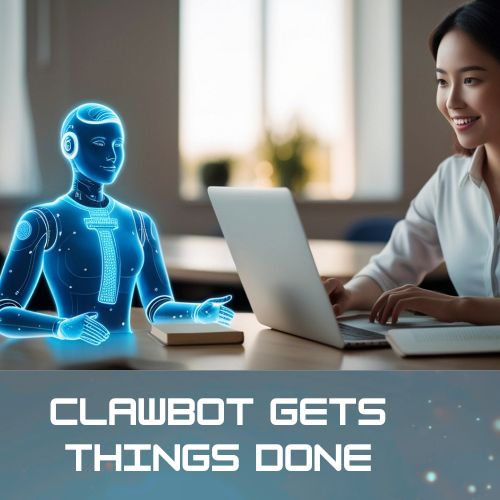
The Moment AI Stopped Being a Novelty
Silicon Valley doesn’t agree on much these days. But for the past two weeks, it has unanimously agreed on one thing: Clawbot is different.
The open-source personal AI agent has exploded across social platforms, tech forums, and developer communities with a speed that surprises even seasoned observers. Mac Mini sales spiked. GitHub stars climbed past 20,000. YouTube videos about viral Clawbot racked up hundreds of thousands of views in days. And unlike previous AI hype cycles, this one isn’t built on promises or demos that never ship.
It’s built on actual execution.
This isn’t another chatbot moment. This is the moment when AI stopped being a novelty you chat with and became a tool that actually works on your behalf autonomously, persistently, and without constant hand-holding.
If you’re in tech, media, business, or policy, understanding viral Clawbot is no longer optional. It signals a fundamental shift in how AI will be deployed, owned, and integrated into daily work. And the timeline for that shift is 2026, not 2030.
This article is your guide to understanding why.
What Is Viral Clawbot? Beyond the Hype
Let’s start with a clear definition, because most coverage gets this wrong.
Clawbot is not a chatbot. It’s not a conversational AI that sits in a browser window answering questions. It’s a local-first, autonomous AI agent that runs continuously on hardware you control and can execute tasks with minimal oversight.
Think of it less like ChatGPT and more like hiring a digital employee who:
- Never sleeps
- Never forgets what you told it
- Can control your computer, files, calendar, email, and web browser
- Can make phone calls, send messages, and trigger workflows
- Communicates through apps you already use (WhatsApp, Discord, Slack, Signal, iMessage, Teams)
- Gets smarter and more attuned to your preferences over time
Viral Clawbot works like this: You send a message from your phone. That message reaches an AI agent running on a Mac Mini, Linux box, Raspberry Pi, or $5 VPS sitting in a data center. The agent reads your instruction. It accesses your computer. It executes the task. It reports back. No browser refresh. No API calls to a cloud platform. No lag. No context loss.
This is why the term “viral Clawbot” resonated so hard. It’s not that the tool is new. It’s that it finally works the way people expected AI assistants to work five years ago.
Dive deeper into setup — click here for the installation guide.
The Three Capabilities That Make Clawbot Radical
1. Near-Total Computer Control: The “AI Employee” Effect
Clawbot doesn’t operate inside a walled sandbox. It can control nearly everything a human can control on a computer.
Click buttons. Type text. Browse the web. Fill forms. Send emails. Execute shell commands. Open applications. Schedule tasks. Control smart home devices. Even make phone calls using voice synthesis.
This is why early adopters describe it as having “a digital employee on your computer.”
The implication is staggering. If an AI can control a computer, it can automate work that previously required human intervention. Not hypothetically. In practice. Right now.
Users are already reporting:
- Automating restaurant reservations by having the AI call the restaurant directly when web booking fails
- Building customer support workflows that handle 80% of inbound messages without human input
- Running job application campaigns across dozens of sites simultaneously
- Executing trades, monitoring accounts, and rebalancing portfolios
- Managing multiple social media accounts 24/7 with zero human oversight
That last point matters. This isn’t automation theater. This is real work compression.
2. Long-Term Memory That Actually Persists: The Memory Architecture Shift
Most AI tools have memory theater. They maintain context within a single conversation. Close the tab, start a new chat, and the context resets. That’s not memory. That’s a magic trick.
Clawbot has genuine memory architecture.
Every conversation is automatically summarized. Key facts are extracted. Preferences, habits, projects, and ongoing tasks are stored in long-term memory files that persist across sessions, devices, and conversations.
Tell Clawbot about a meeting on Friday. Ask it about that meeting next week. It remembers.
This isn’t a feature. This is the foundation of genuine productivity. Because memory enables context. And context enables autonomy.
Users are reporting memory banks that span weeks of interactions, learning their:
- Work preferences and communication style
- Recurring tasks and preferred workflows
- Calendar patterns and availability windows
- Financial accounts and automation boundaries
- Smart home configuration and device preferences
One early adopter, Federico Viticci at MacStories, reported burning through 180 million tokens in his first week, automating nearly every subscription-based workflow he previously paid for. The secret wasn’t the model. It was that the AI remembered what he wanted without being re-prompted.
3. Chat as the Interface, Everywhere: The Omnichannel Execution Layer
Clawbot doesn’t force you into a new UI. It lives inside the chat apps you already use.
Work from WhatsApp on your phone. Trigger tasks from Discord on your laptop. Send voice messages instead of typing. Use iMessage if you’re on macOS. Jump between Slack, Telegram, and Signal without losing context.
The magic is simple: One agent, infinite channels, persistent memory.
A widely shared demo shows Clawbot failing to reserve a restaurant via OpenTable. Instead of stopping, it:
- Detected the failure
- Used ElevenLabs voice synthesis to synthesize human speech
- Called the restaurant directly
- Spoke to a human and negotiated the reservation
- Confirmed the booking and sent you a message
That’s not AI falling back to a human. That’s AI making a strategic decision and adapting.
Why Viral Clawbot Went Viral (When Others Didn’t)
Dozens of AI tools launched before 2026. Few went viral. Fewer still achieved mainstream adoption.
Clawbot crossed that threshold because it hit three inflection points simultaneously.
The End of AI Fatigue
People are exhausted by AI demos. They’re tired of promises. They’ve sat through countless presentations showing an AI answering trivia questions or writing emails—impressive in 2022, meaningless in 2026.
Viral Clawbot flipped the value proposition. Instead of “this AI can answer your questions better,” it says “this AI will do your work while you sleep.”
That’s not a feature. That’s a lifestyle change.
Local-First Is the New Trust Signal
For a decade, the tech industry moved everything to the cloud. Convenience. Scalability. Automatic updates.
But trust eroded. Privacy concerns accumulated. Data breaches multiplied. People began asking: Do I really want my most sensitive information on someone else’s servers?
Clawbot answered that question by design. It runs on your hardware. Your data stays local. You own the entire stack.
For power users, founders, and security-conscious professionals, that’s not a selling point. It’s a prerequisite.
“Always-On” Became Aspirational
A 24/7 AI employee that doesn’t sleep, forget, or context-switch? That narrative is inherently viral because it aligns perfectly with how solopreneurs and lean teams want to scale in 2026.
You can’t hire a human to work 24/7. You can’t manage 10 freelancers and stay sane. But you can run an AI agent.
That promise—autonomy without burnout—is what drove the viral moment.
Viral Clawbot vs ChatGPT: Why This Distinction Matters
This is the line in the sand. Understanding the difference is understanding why 2026 is different from 2025.
| Dimension | ChatGPT | Viral Clawbot |
|---|---|---|
| Where it lives | Someone else’s servers (cloud) | Your hardware (local-first) |
| Persistence | Stateless; context resets each conversation | Persistent memory across all sessions |
| Computer access | None; it can only type responses | Full system access (files, apps, commands) |
| Proactivity | Entirely reactive; waits for your prompt | Can schedule tasks, send alerts, work independently |
| Ownership | Proprietary; hosted by a third party | Open-source; you control the entire stack |
| Execution model | Answers questions | Executes workflows and makes decisions |
ChatGPT gives you answers. Viral Clawbot gives you outcomes.
That distinction is going to compound every month of 2026.
The Security Debate: Why It Validates, Not Invalidates
Yes, there are legitimate security concerns. Clawbot has shell access to your computer. Improperly configured, it could theoretically access sensitive files, send unauthorized emails, or execute unintended commands.
GitHub shows over 500 open security issues. Early documentation warns against installing it on your primary machine.
But here’s what critics miss: this debate is not slowing adoption. It’s validating relevance.
When a tool becomes powerful enough to require security discussion, it has crossed a threshold from toy to tool.
Early adopters mitigate risks through:
- Running isolated instances in separate VMs or containers
- Implementing permission allowlists and pairing approvals
- Sandboxing tool execution
- Separating credentials and browser profiles
- Regular security audits
Interestingly, founder Peter Steinberger deliberately left 0.00001% of the code closed-source in a file called “soul.” It’s both a personal safeguard and a honeypot. If someone breaks it, he’ll know the security model failed.
So far, it hasn’t been stolen.
Why Everyone Is Buying Mac Minis (And Why You Don’t Have To)
The first sign of a category breakout? Hardware sales spike for adjacent products.
Clawbot users started buying Mac Minis. Then Mac Studios. Then whole clusters of machines. The Mac Mini became the de facto platform, driving Apple sales in unexpected ways.
Why Mac Mini?
- Quiet operation
- Low power consumption
- Good macOS compatibility
- iMessage support (unique to macOS)
- Cheap ($500-600)
- Takes up minimal space
But here’s the reality: hardware is optional.
A $5/month VPS from Hetzner or DigitalOcean runs Clawbot just fine. A Raspberry Pi 4 ($50-100) works. An old laptop from 2015 running Linux works.
The real cost is the AI model subscription ($20-200/month depending on usage), not the hardware.
The Mac Mini trend signals adoption momentum, not necessity.
What This Means for the Future of Work
Here’s the uncomfortable truth that nobody in HR departments is ready to hear:
A single motivated individual with viral Clawbot can now do the work of small teams.
Not tomorrow. Not hypothetically. Today.
This doesn’t mean mass layoffs next quarter. But it does signal structural reorganization:
- Knowledge work will consolidate around AI-augmented individuals
- Ownership of data and workflows will matter more than access to tools
- Chatbots will feel increasingly obsolete
- Teams will shrink while output remains constant
- Geographic arbitrage (hiring cheap talent in low-cost countries) will become less relevant
Big companies will respond. They always do. But open-source systems move faster. And viral Clawbot is already here.
The 2026 Outlook: From “Vibe Coding” to “Vibe Orchestration”
One of the most telling quotes from early adopters: “Vibe Coding is dead. Vibe Orchestration is here.”
This phrase encapsulates the shift.
Vibe Coding meant writing rough code and letting AI clean it up. It was still human-led.
Vibe Orchestration means you describe intent, and the AI coordinates systems, tools, models, and workflows to achieve it. The human specifies direction. The agent fills in all the details.
Some users report not touching traditional IDEs for days while their Clawbot instance works continuously on complex tasks—writing code, integrating APIs, debugging, iterating, and shipping.
That shift is irreversible.
Bottom Line: Own the Explanation Layer, Not the News Cycle
Most media outlets will chase the headlines. “Viral Clawbot Explodes,” “Mac Mini Sales Spike,” “Is AI Stealing Jobs?”
Those stories matter. But they’re noise.
The real leverage is owning the explanation layer.
Viral Clawbot is not a trend. It’s a prototype of how AI agents will operate in 2026 and beyond. It signals a fundamental shift from conversational AI to operational AI.
The companies, publications, and individuals who understand that shift first will own the narrative.
What Comes Next
Clawbot is open-source. The community is shipping updates hourly. Security is being hardened. New capabilities are being added daily.
In six months, the tool will be materially better than it is today.
In 12 months, competitors will emerge—some open-source, some proprietary.
But Clawbot will have first-mover advantage. And more importantly, it will have credibility.
That credibility—earned through execution, not marketing—is what made it viral.
And that’s why 2026 is the year of the personal AI agent.
Key Takeaways
- Viral Clawbot is not a chatbot. It’s an autonomous AI agent that runs on your hardware, executes real work, and remembers everything.
- The shift from conversational AI to operational AI is irreversible. Once people experience a 24/7 AI employee, chat-based assistants feel inadequate.
- Local-first is the new trust signal. Running AI on personal hardware, not cloud servers, is reshaping how people think about data ownership.
- Security concerns validate adoption, not slow it. Powerful tools require careful configuration. That’s a feature, not a bug.
- This is the beginning, not the peak. Viral Clawbot is a prototype. The category it defines will dominate 2026 and beyond.
Frequently Asked Questions
Q: Do I need expensive hardware to run Clawbot?
A: No. A $5/month VPS or old laptop works fine. The cost is primarily the AI model subscription, not hardware.
Q: Is Clawbot safe?
A: It’s powerful and requires careful configuration. Run it in isolated environments initially. Use permission allowlists. The risk is real but manageable.
Q: Will Clawbot replace my job?
A: Not directly. But it will compress workflows and reduce headcount needs. Teams will reorganize around AI-augmented individuals.
Q: Can I use Clawbot with free AI models?
A: Yes, but quality suffers. Claude and GPT-4 handle complex tasks better. Smaller models work for basic automation.
Q: Why is everyone buying Mac Minis?
A: Convenience and iMessage support. But it’s not necessary. Any hardware running macOS, Windows, or Linux works.
Ready to Explore Further?
If you want to understand the future of AI work, viral Clawbot is where to start.
Not because it’s the best tool. But because it’s the most honest one.
It doesn’t promise to answer your questions better. It promises to do your work. And for the first time, AI is keeping that promise.
That’s why it went viral. And why 2026 is going to be very different from 2025.
For more deep dives into the technology shaping our world, keep reading Welp Magazine, your source for the latest in tech, startups, and innovation.