For a while now, the question people asked about a new AI model was simple: does it write a good answer?
That question is basically settled.
The one worth asking now is different can the model take a goal, break it into steps, open the right tools, and hand back finished work without someone babysitting every move?
That’s the fight OpenAI and Anthropic just picked with each other.
OpenAI shipped GPT-6 Astra on September 3, 2026, calling it their most capable and best-aligned model yet, with a heavy emphasis on computer use, browsing, coding, cybersecurity, and general professional work. Two days earlier, Anthropic put out Claude Fable 5.1, pitched as its strongest model for coding and knowledge work, with real gains on long, multi-step agent tasks.
Same race, different route.
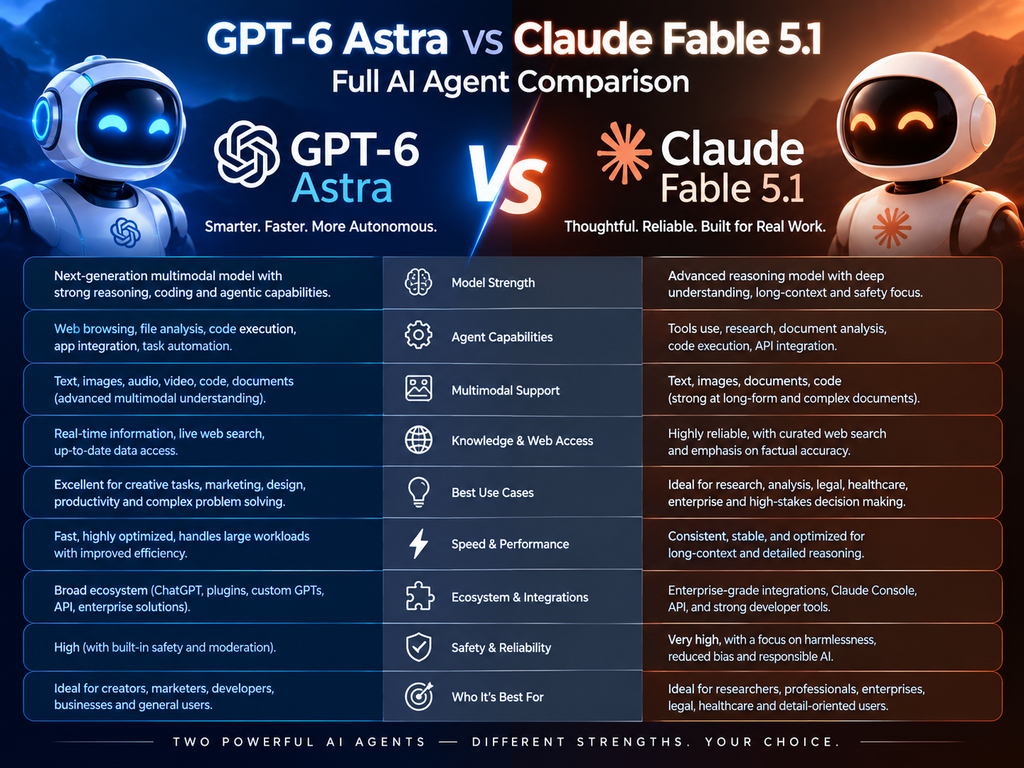
Quick Comparison
| Feature | GPT-6 Astra | Claude Fable 5.1 |
|---|---|---|
| Maker | OpenAI | Anthropic |
| Launched | Sept 3, 2026 | Sept 1, 2026 |
| Built around | Agents, computer use, professional reasoning | Coding, research, agentic workflows |
| Input price (API) | $10 / 1M tokens | $10 / 1M tokens |
| Output price (API) | $50 / 1M tokens | $50 / 1M tokens |
| Cached input | $1 / 1M tokens | $0.25 / 1M tokens |
| Computer use | Headline feature | Solid, not the focus |
| Coding | Frontier-level | Frontier-level |
| Cybersecurity | Critical-level capability | Strong, more restricted |
| Where it runs | ChatGPT, API, Azure, AWS | Claude, API, AWS, Google Cloud, Microsoft Foundry |
Pricing reflects each company’s current published numbers and can shift as both platforms update.
What GPT-6 Astra Actually Does
Astra’s whole pitch is that it doesn’t just answer you — it operates your computer for you. OpenAI says it can fill out web forms, update CRM records, sort a calendar, research something online, spin up a basic website, work through scientific data, run frontend QA, and install or troubleshoot software.
That’s a real shift from how most people still use AI. Instead of asking “how do I update 50 customer records” and doing it yourself, you point Astra at the task and, within whatever permissions and tools you’ve given it, it does the clicking.
OpenAI’s benchmark numbers are eye-catching: 98% on FrontierMath Tier 4, 99.9% on ARC-AGI-3, 100% on ExploitBench, and 72.6% on OSWorld 2.0 — reportedly about 47% faster than GPT-5.6 Sol on the same task set. Worth remembering, though, that these are OpenAI’s own reported results. They tell you what OpenAI’s tests show, not necessarily how the model performs on your actual workload.
What Claude Fable 5.1 Actually Does
Fable 5.1 leans the other direction — deep coding and sustained knowledge work rather than screen operation. Anthropic built this model for developers and researchers running long agent sessions against large codebases or document sets.
The standout detail is cache pricing. Fable 5.1 charges $0.25 per million tokens for cached input, a quarter of Astra’s $1 rate. Anthropic says this cuts typical workload costs by roughly 25%, and up to 45% for heavily agentic jobs. If your agent keeps hitting the same codebase or knowledge base over and over, that difference adds up fast.
Anthropic also points to a notable research demonstration: Claude reportedly worked largely on its own for 11 days to produce a computer-checked formalization of Fermat’s Last Theorem in Lean. That’s a genuinely impressive show of sustained, autonomous mathematical work — though it’s a formalization exercise, not the model inventing a new proof from scratch.
Coding: Which One Wins?
This is close enough that “it depends” is the honest answer.
Astra pairs code generation with the ability to actually run and test that code inside a real environment — install packages, run QA, debug what’s on screen. Fable 5.1 leans harder into reasoning through complex, long-running coding and research tasks, with the Fermat project as its calling card.
Verdict: Slight edge to Fable 5.1 for extended coding and research sessions. Astra pulls ahead when the job needs the model to actually operate a dev environment, not just write to it.
Computer Use: No Contest
This is where Astra separates itself. OpenAI built the entire launch narrative around a model that can navigate real interfaces — websites, business software, internal tools — and get through multi-step digital tasks that used to need custom scripts or a human at the keyboard.
Picture a content workflow: research competitors, pull keyword data, work through a spreadsheet, draft the piece, upload it to a CMS, fill in metadata, check internal links, review the live page, prep social captions, and pull a performance report. A model that can safely operate the actual software involved could carry a lot of that load on its own.
Verdict: GPT-6 Astra, clearly. This is its strongest card.
Research: Nearly a Tie
Both companies are chasing the same goal here, just from different angles. Fable 5.1’s strength is depth — long, coding-heavy, document-heavy investigation, with the Fermat work as proof of concept. Astra’s strength is breadth — research that flows straight into action across websites and apps without a handoff to a human.
Verdict: Pick based on your workflow. Research that stays inside documents and code favors Fable 5.1. Research that needs to end in clicks and uploads favors Astra.
Pricing: Fable 5.1 Wins on the Details
Sticker prices are identical — $10 per million input tokens, $50 per million output tokens, for both. The gap shows up in cache pricing, where Fable 5.1’s $0.25 rate undercuts Astra’s $1 by a wide margin. For any team running repeated agent calls against the same context — which is most serious agentic use — that’s a meaningful cost advantage over time.
Verdict: Fable 5.1, on caching economics.
Cybersecurity: Astra’s Sharpest Edge (and Its Biggest Risk)
OpenAI says Astra is the first model to hit the “Critical” tier of cybersecurity capability under its own Preparedness Framework — meaning that, given the right tools and access, it can find unknown vulnerabilities and build working exploits against hardened systems with minimal human guidance.
That’s a genuine capability leap, and a genuine risk. The same skill that makes a model useful for defensive security research is the skill that makes it dangerous in the wrong hands. OpenAI says it added tighter isolation, checkpoint encryption, and trajectory monitoring in response. For anyone deploying Astra, that means access controls and human oversight aren’t optional extras — they’re the whole ballgame.
Verdict: GPT-6 Astra leads on raw capability, but this is also the category demanding the most caution from anyone rolling it out.
Safety and Trust Matter More Than the Scoreboard
Raw intelligence isn’t the only thing worth grading here. As these models get more autonomous, questions about data handling, permissions, audit trails, and human sign-off start to matter as much as benchmark scores.
Before adopting either model at scale, it’s worth checking each vendor’s data retention rules, enterprise privacy controls, permission settings, audit logging, approval workflows, tool access limits, and compliance posture. Anthropic publishes system cards detailing safety evaluations for its models; OpenAI has published its own added safeguards for Astra given its cybersecurity rating. Neither replaces doing your own homework.
The strongest model on paper isn’t automatically the right one for your business — the right one is whichever gets the job done inside a risk level you’re actually comfortable with.
Which Should You Actually Use?
Reach for GPT-6 Astra if you need:
- An agent that operates real business software, not just answers questions
- Browser and interface automation
- Software testing and QA
- Serious cybersecurity or exploit research
- Multi-step professional tasks that end in a finished document, deck, or spreadsheet
Reach for Claude Fable 5.1 if you need:
- Deep, sustained coding work
- Long research sessions across large document sets
- Lower costs on repeated, context-heavy agent runs
- A model built around code and knowledge rather than screen operation
For Publishers and Marketers Specifically
Fable 5.1 fits naturally into the research-and-writing side: competitor scans, content briefs, technical explainers, long-form drafts, data reads, content audits. Astra becomes more interesting once the job includes actually doing something with that output — logging into a CMS, updating metadata, checking a live page, filling out a form, or building a report.
That points to a real shift in how content teams could work: instead of a human bouncing between the AI and the CMS at every step, the AI handles more of the execution directly, with a human reviewing before anything goes live.
Don’t Let Benchmarks Make the Decision For You
Benchmark tables are useful for comparing models on a level field, but no business actually runs on benchmarks — it runs on CRMs, spreadsheets, dev environments, support tickets, and marketing platforms. A model that tops a leaderboard can still struggle inside your specific stack.
If you’re choosing between these two for real work, test both on your own representative tasks and weigh accuracy, completion rate, speed, cost, reliability, safety, and how often a human has to step in — not just the intelligence score.
The Bottom Line
There’s no single winner here, because they’re not really solving the same problem.
GPT-6 Astra is built for AI that operates a computer and gets through real digital tasks on its own — its computer-use and cybersecurity capabilities are the standout features.
Claude Fable 5.1 is built for sustained coding and research work, backed by pricing that rewards repeated, heavy agent use.
Both are aimed at the same destination: AI that does the work instead of just describing how to do it. The real question for any business isn’t which model scores higher — it’s which parts of your workflow are ready to become agent-run, and where you still want a human’s hand firmly on the wheel.
FAQ
Is GPT-6 Astra better than Claude Fable 5.1?
Neither is better across the board. Astra leads on computer use and cybersecurity capability; Fable 5.1 leads on long-running coding, research depth, and cache pricing. The right pick depends on the task.
What is GPT-6 Astra used for?
OpenAI positions it for agentic tasks that involve operating a computer directly — filling forms, running QA, browsing and researching online, and handling multi-step professional work with limited human input.
What makes Claude Fable 5.1 different from earlier Claude models?
Anthropic built it around coding and knowledge work, with major cost cuts on cached input (down to $0.25 per million tokens) aimed at long, repeated agent sessions.
Are GPT-6 Astra and Claude Fable 5.1 the same price? Standard token pricing is identical at $10 per million input and $50 per million output tokens. The real difference is cached input: $1 per million for Astra versus $0.25 per million for Fable 5.1.
Why does GPT-6 Astra’s cybersecurity rating matter?
OpenAI classifies it as the first model to reach “Critical” cybersecurity capability under its Preparedness Framework, meaning it can find and exploit unknown vulnerabilities with minimal guidance. That’s powerful for defensive research and genuinely risky if access isn’t tightly controlled.
Which model is cheaper for AI agents that run constantly?
Claude Fable 5.1, mainly because of its lower cached-input pricing Anthropic estimates savings of up to roughly 45% on heavily agentic workloads.