By Welp Magazine | May 2026
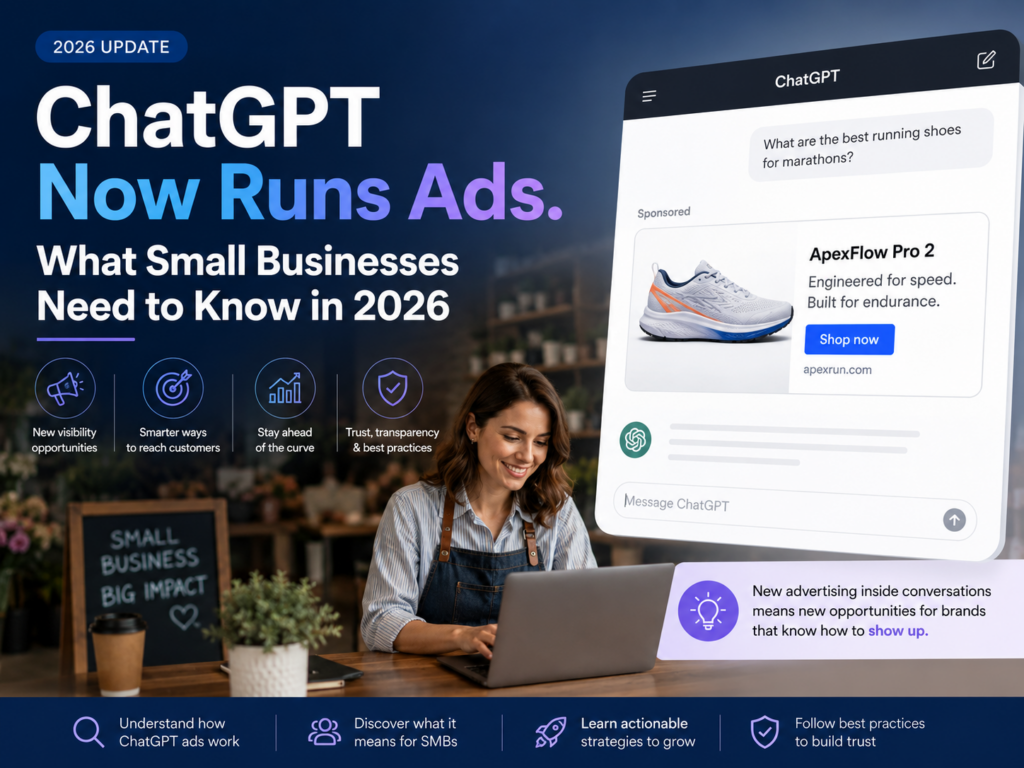
OpenAI has officially opened ChatGPT advertising to U.S. small and midsize businesses. The platform now includes a self-serve Ads Manager, a cost-per-click bidding model, and third-party integrations with Adobe, Criteo, Pacvue, and Kargo. For businesses looking for alternatives to rising Google Search ad costs, this is the most significant new advertising surface to arrive in years.
Here is a full breakdown of how it works, who it is for, and what to do about it.
What Is the ChatGPT Ads Manager?
The ChatGPT Ads Manager is OpenAI’s self-serve advertising platform, currently in beta for U.S. businesses. It allows companies to set budgets, launch campaigns, and track performance directly inside ChatGPT without going through an OpenAI sales team.
OpenAI also launched a Conversions API and pixel-based measurement alongside the Ads Manager, giving advertisers a way to track actions that happen after someone engages with an ad inside the platform. Advertisers receive aggregated performance data but do not get access to individual user conversations.
How Does ChatGPT Advertising Work?
ChatGPT advertising uses conversational intent targeting rather than keyword-based targeting. This means ads are matched to the context of what a user is discussing, not a specific search term they typed.
When a user inside ChatGPT is researching a product purchase, comparing services, or planning a trip, the platform serves a contextually relevant ad based on the conversation in progress. OpenAI gave the example of a rental car company appearing in a conversation where someone is actively planning travel.
This is a fundamentally different advertising model from Google Search. The user is not scanning a results page. They are mid-conversation, mid-decision, and the ad appears inside that high-intent moment.
ChatGPT CPC Bidding: How the Pricing Model Works
OpenAI launched a cost-per-click bidding model for ChatGPT ads. Advertisers pay only when a user clicks, not for impressions or reach. This is the lowest-risk entry model for businesses testing a new advertising platform.
The CPC structure is particularly important for small businesses because it removes the risk of paying for passive exposure with no measurable result. Budget control stays with the advertiser, and spend is tied directly to user engagement.
Why Small Businesses Should Consider ChatGPT Ads Now
Google reported $60.4 billion in search and advertising revenue in Q1 2026. Competing on Google Search in high-competition categories has become expensive enough that small budgets produce diminishing returns.
ChatGPT has more than 600 million weekly active users as of early 2026. A large share of those users are in active research and purchase conversations daily. Early entry into a CPC-based ad platform almost always produces better cost efficiency before competition increases and pricing normalizes.
Facebook advertising in 2012, Google Search advertising in 2004, and Instagram advertising in 2015 all had early windows where smaller advertisers captured significant value before costs rose. ChatGPT advertising in 2026 represents a comparable early entry window.
ChatGPT Ads vs Google Search Ads: Key Differences
Google Search ads are triggered by specific keywords in a search query. ChatGPT ads are triggered by conversational intent across an entire exchange. Google targets what someone searched. ChatGPT targets what someone is thinking through.
For purchase-driven categories including travel, software, financial services, consumer products, and health, conversational intent targeting can reach users at a deeper stage of the decision process than a keyword search captures.
FAQs
1.What is ChatGPT advertising?
2.How much does it cost to advertise on ChatGPT?
3.Will ChatGPT ads affect the AI’s answers?
4.Which businesses benefit most from ChatGPT ads?
5.Is ChatGPT advertising available outside the U.S.?
OpenAI is now an advertising company. The CPC model, self-serve tools, and measurement infrastructure it has built are not experimental. They are the foundation of a platform being scaled aggressively ahead of a potential IPO.
For small businesses, the window to enter before costs rise is open right now. The businesses that test, learn, and build familiarity with ChatGPT advertising in 2026 will have a structural advantage once the platform reaches full scale.
ChatGPT ads are just the beginning. The AI landscape is moving fast and the businesses that stay informed are the ones that stay ahead.
Welp Magazine covers the tools, platforms, and strategies that matter to founders and SMBs every week.
Read More Business and AI News on Welp Magazine →