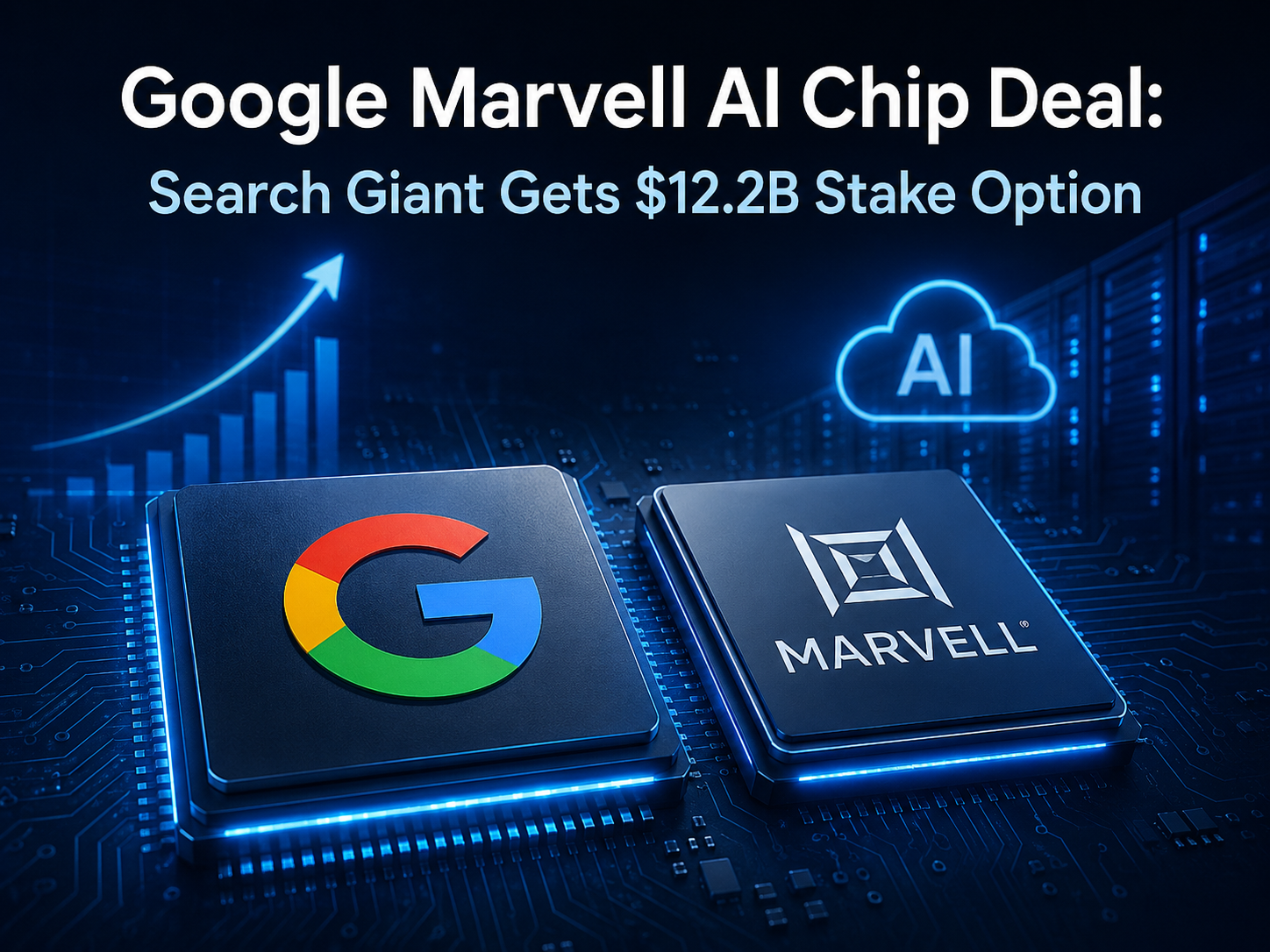
Google has struck a new agreement with chipmaker Marvell Technology that could hand the search giant a multibillion-dollar stake in the company, marking one of the most significant moves yet in the escalating race to build custom AI silicon. Under the terms of the Google Marvell AI chip deal, Marvell has granted Google a warrant to purchase up to 58.97 million shares of Marvell stock at $206.58 apiece a package worth roughly $12.18 billion if Google exercises it in full.
The arrangement, disclosed this week, expands an existing partnership between the two companies and extends it through Marvell’s fiscal 2033. If fully realized, the deal would make Google one of Marvell’s largest shareholders, according to a person familiar with the agreement’s structure, placing it among the chipmaker’s top five investors.
What the deal actually covers
The partnership isn’t limited to a single chip. It spans a broad range of technologies that support Google’s tensor processing units (TPUs), the custom silicon Google has spent years developing to run its AI models more efficiently than off-the-shelf GPUs allow. Marvell’s role includes processors that execute AI workloads, components that manage data storage, and networking silicon that moves information between chips at the scale required for training and running large models.
That breadth matters. Google has increasingly leaned on custom accelerators to reduce its dependence on Nvidia GPUs, and TPUs have become central to both its internal AI research and the infrastructure it rents out through Google Cloud. Marvell has positioned itself as a key partner in that strategy, designing custom silicon for hyperscale cloud providers rather than competing directly with Nvidia’s general-purpose chips.
Why the stake option is structured the way it is
Notably, most of the warrant doesn’t vest automatically. Google will only gain access to the bulk of the shares if it meets specific purchasing targets with Marvell over the life of the agreement, which runs through fiscal 2033. That structure ties Google’s potential ownership stake directly to how much custom silicon it actually buys — effectively aligning Marvell’s upside with continued, sustained demand rather than a one-time commitment.
Analysts following the deal noted that if Google hits those purchasing targets, the agreement could generate roughly $120 billion in revenue for Marvell through fiscal 2033. That figure underscores how much money is now flowing through the custom AI chip supply chain, as hyperscalers pour capital into building out data center capacity for generative AI workloads.
Market reaction
Investors responded quickly. Marvell shares jumped nearly 8% to 10% following the announcement, reflecting the market’s view that a long-term commitment from Google — one of the largest cloud and AI infrastructure spenders in the world — significantly de-risks Marvell’s growth outlook. The move also reinforces Marvell’s standing as a serious alternative to Broadcom in the custom AI silicon market.
That competitive dynamic showed up immediately in trading: shares of Broadcom, which has its own custom chip partnerships with other hyperscalers, fell more than 5% on the news. The drop suggests investors see the expanded Google-Marvell agreement as a signal that Google may be diversifying or deepening its custom silicon relationships in ways that could reduce Broadcom’s share of that business over time.
The bigger picture in the AI chip race
The deal lands at a moment when custom AI silicon has become one of the most closely watched fronts in the broader AI infrastructure buildout. While Nvidia continues to dominate the market for general-purpose AI accelerators, hyperscalers including Google, Amazon, and Microsoft have all invested heavily in custom chip programs designed to cut costs and reduce reliance on any single supplier. Google’s TPU program is among the most mature of these efforts, and deals like this one with Marvell suggest the company intends to keep scaling that infrastructure aggressively over the next several years.
For Marvell, the agreement represents validation of its strategy to compete for hyperscaler business through custom design work rather than off-the-shelf products. Landing a long-term, revenue-linked commitment from a company of Google’s scale gives Marvell a degree of visibility into future demand that’s relatively rare in the semiconductor industry, where capital-intensive manufacturing decisions often have to be made years in advance of actual revenue.
Neither Google nor Marvell has disclosed additional financial terms beyond the warrant structure and the fiscal 2033 timeline. The companies’ existing collaboration on custom silicon has been underway for several years, and this expanded agreement appears to formalize a longer runway for that work rather than introduce an entirely new line of business.
As the AI infrastructure buildout continues, deals structured around long-term purchasing commitments — rather than simple one-off supply contracts — may become more common, giving chipmakers greater certainty and hyperscalers more leverage to negotiate favorable terms in exchange for guaranteed volume.
FAQ
What is the Google Marvell AI chip deal?
It’s an expanded partnership in which Marvell granted Google a warrant to buy up to $12.2 billion worth of Marvell stock, tied to Google meeting custom AI chip purchasing targets through fiscal 2033.
How much is Google’s potential stake in Marvell worth?
Up to roughly $12.18 billion, based on a warrant covering 58.97 million shares at $206.58 each.
What does the deal cover?
Technologies supporting Google’s TPUs, including processors that run AI models, data storage management chips, and networking silicon.
How did the stock market react?
Marvell shares rose about 8-10% on the news, while Broadcom shares fell more than 5%.
How much revenue could the deal generate for Marvell?
Roughly $120 billion through fiscal 2033, if Google meets the agreed purchasing targets.