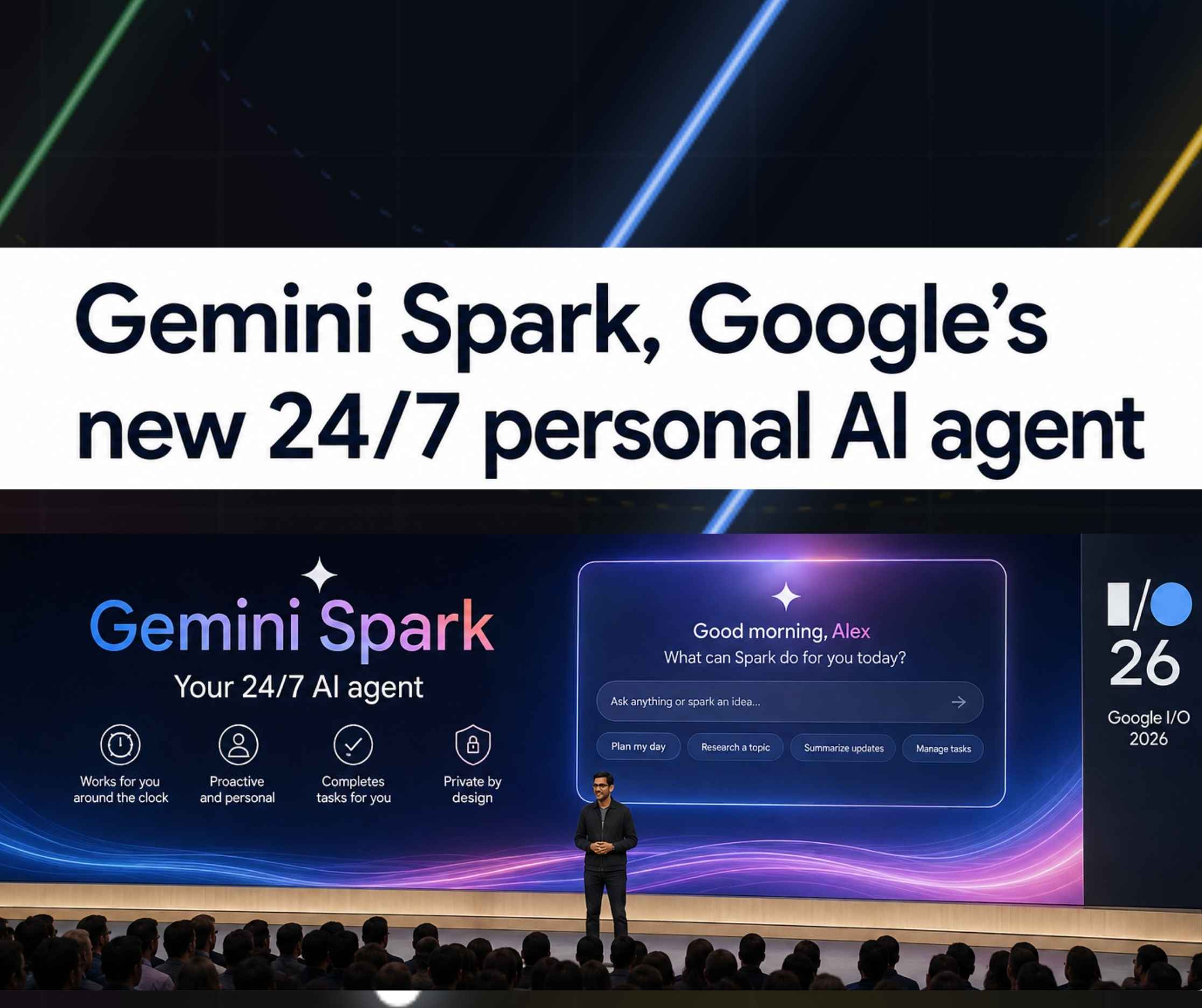
Gemini Spark, Google’s new 24/7 personal AI agent, is the centrepiece of the most ambitious product announcement the company has made in over two decades. Unveiled at Google I/O 2026 on May 19, Spark arrives alongside a complete overhaul of Google Search, the launch of proactive information agents, and a series of Gemini upgrades that together mark a defining turning point in how people interact with technology.
This is not a feature update. It is a fundamental reimagining of what Google does and what AI can do for you.
Table of Contents
- What Is Gemini Spark?
- Google Search Gets Its Biggest Redesign in 25 Years
- Information Agents: Search That Keeps Working After You Leave
- What Gemini Spark Can Actually Do
- How Does Gemini Spark Compare to the Competition?
- Who Can Access Gemini Spark And What Does It Cost?
- What This Means for Publishers and the Open Web
- FAQs
1. What Is Gemini Spark?
Gemini Spark is Google’s answer to the personal AI agent race and it may be the most capable entry yet. Announced by Alphabet CEO Sundar Pichai at Google I/O 2026, Spark is a 24/7 agentic assistant built on Gemini 3.5 and Google’s internal Antigravity harness, a framework designed to execute long-horizon, multi-step tasks with minimal human oversight.
Unlike traditional AI assistants that wait for a prompt, Gemini Spark runs continuously on dedicated Google Cloud virtual machines. You do not need to keep your laptop open. You do not need to check in. Spark simply works in the background, across your apps, around the clock.
“It’s your personal AI agent that helps you navigate your digital life, taking action on your behalf and under your direction,” Pichai told reporters at a pre-briefing ahead of the keynote.
2. Google Search Gets Its Biggest Redesign in 25 Years
While Gemini Spark grabbed headlines, the redesign of Google Search may prove to be the most consequential announcement of the event. Google described it as the most significant update to the Search interface in over 25 years — a complete departure from the keyword-and-blue-link model that has defined internet search since the late 1990s.
The new Search box supports natural language queries, multimedia inputs including images, documents, and videos, and even open Chrome tabs as contextual input. Users no longer need to summarise their problem into a few keywords they can describe it fully, share supporting files, and receive an intelligent, contextual response.
Google has also upgraded autocomplete using Gemini 3.5 Flash. Rather than predicting the next word, the model now helps users shape complete, well-formed questions as they type acting as a co-author of the query itself.
AI Overviews and AI Mode are now blended into a seamless continuum. Users who continue a conversation after receiving an AI-generated summary automatically transition into AI Mode, where Search remembers previous context and handles follow-up questions like a full conversational AI. AI Mode has already surpassed 1 billion monthly active users since its launch one of the fastest adoption curves in Search history.
3. Information Agents: Search That Keeps Working After You Leave
One of the most genuinely novel announcements at I/O 2026 was the introduction of information agents personalised AI systems that monitor the web continuously on behalf of users, long after the browser tab is closed.
Rather than requiring users to repeatedly check websites for updates, information agents allow people to set a monitoring instruction once and receive alerts only when something relevant happens. Google demonstrated agents tracking apartment listings, product availability, sports updates, and social media activity in real time.
In one practical example shown on stage, a user searching for a specific sneaker in their size could configure an information agent to scan online stores automatically — sending a notification only when the product became available. No refreshing. No manual checks. The agent handles it entirely.
Google confirmed that information agents will be capable of tracking websites, online marketplaces, and social platforms, with broader rollout expected later in summer 2026 for Google AI Pro and Ultra subscribers.
4. What Gemini Spark Can Actually Do
Gemini Spark integrates natively with Gmail, Google Docs, Sheets, and Slides — giving it immediate access to the data that powers the most useful productivity workflows without any manual setup.
Demonstrated use cases at Google I/O 2026 included:
- Summarising email threads and flagging upcoming deadlines
- Generating status update reports from meeting notes, Docs, and Slides
- Drafting and sending follow-up emails on the user’s behalf
- Monitoring monthly credit card bills to automatically detect suspicious charges or hidden fees
- Managing customer inbox monitoring for small businesses
Users can interact with Spark through the Gemini app, via a dedicated Gmail address, or — later this summer — directly through Chrome as a full agentic browser. On Android, a new UI space called Android Halo will allow users to monitor Spark’s live task progress from their mobile device.
Google has also confirmed third-party integrations with Canva, OpenTable, and Instacart at launch, with additional MCP-based connections planned across the coming months.
Importantly, users retain control. Spark requires explicit approval before taking sensitive actions such as sending emails or making purchases — a safeguard designed to address concerns around autonomous AI behaviour.
5. How Does Gemini Spark Compare to the Competition?
The personal AI agent space is now one of the most competitive in technology. Gemini Spark enters a market that already includes Anthropic’s Claude Cowork and OpenAI’s ChatGPT agent — both of which have attracted significant user bases.
Where Spark differentiates itself is integration depth. Competitors require users to manually configure connections to their email, calendar, and productivity apps. Spark arrives with native, zero-setup access to the entire Google Workspace ecosystem. For the hundreds of millions of people already using Gmail, Docs, and Google Drive daily, the barrier to getting value from Spark is essentially zero.
That structural advantage — sitting inside the tools people already use — could prove decisive in the agent wars ahead.
6. Who Can Access Gemini Spark — And What Does It Cost?
Google is rolling out Gemini Spark to trusted testers immediately, with the public beta arriving for Google AI Ultra subscribers in the US the week of May 20, 2026.
AI Ultra is Google’s new premium subscription tier priced at $100 per month, positioned for developers, creators, and power users. It includes access to Gemini Spark, the latest Gemini 3.5 models, and priority access to new features as they launch.
Information agents in Search will roll out more broadly over summer 2026, starting with Google AI Pro and Ultra subscribers before expanding to a wider audience.
7. What This Means for Publishers and the Open Web
Google’s I/O 2026 announcements carry significant implications for the wider web ecosystem. As Search increasingly answers queries directly through AI-generated summaries, and as information agents retrieve and monitor content on users’ behalf, fewer people may feel the need to visit external websites at all.
For publishers, content creators, and online businesses already navigating declining referral traffic from Google, this represents a fresh and serious pressure point. The shift from Search as a discovery tool to Search as a completion engine fundamentally alters the value exchange between Google and the broader internet.
Google acknowledged this tension, confirming that traditional blue-link results are not disappearing. Users who prefer the classic browsing experience will still be able to access standard search results through a dedicated Web tab.
Whether that commitment holds as AI Mode and information agents mature remains to be seen. What is clear is that the relationship between Google, its users, and the open web has entered a new and consequential chapter.
Quick Facts: Gemini Spark at Google I/O 2026
| Detail | Info |
|---|---|
| Announced | Google I/O 2026, May 19 2026 |
| Powered by | Gemini 3.5 + Antigravity harness |
| Availability | AI Ultra Beta (US), week of May 20 2026 |
| Price | $100/month (AI Ultra) |
| Native integrations | Gmail, Docs, Sheets, Slides, Chrome |
| Third-party apps | Canva, OpenTable, Instacart + MCP |
| Mobile | Android Halo (coming later 2026 |
Frequently asked questions
Everything you need to know about Gemini Spark
Your top questions about Google’s 24/7 AI agent and the Google I/O 2026 announcements — answered.
Source: gemini.google/overview/agent/spark