Robotaxi Race 2026 and Global Shift
Robotaxi race 2026 is now accelerating into a defining phase of global mobility transformation, where autonomous vehicles are moving from experimental pilots into industrial-scale deployment. The competition is no longer theoretical. It is operational, capital-intensive, and deeply tied to how future cities will function.
Across China and the United States, two very different execution models are emerging. One is manufacturing-led and infrastructure-driven. The other is software-led and vision-driven. Together, they are reshaping the global transportation stack.
XPeng Robotaxi Production Strategy
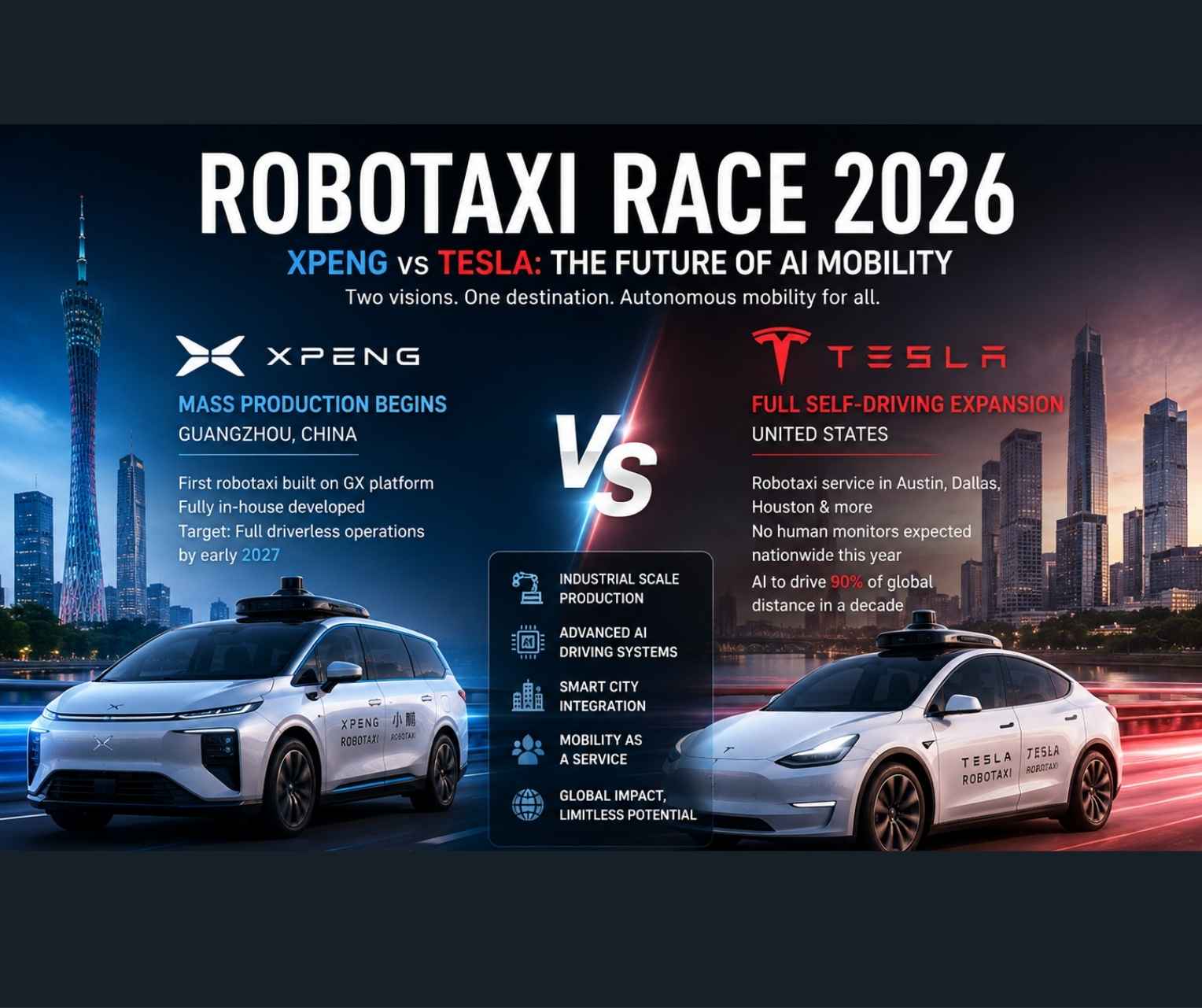
XPeng Inc has begun mass production of its first robotaxi in Guangzhou, marking a major structural shift from prototype development to large-scale industrial output.
Built on its GX platform, the vehicle represents a fully integrated autonomous system developed in-house. This approach gives XPeng control over hardware design, AI driving systems, and deployment architecture within a single ecosystem.
The company is targeting fully driverless commercial operations by 2027, signaling a long-term execution roadmap rather than a short-term pilot strategy.
Guangzhou is quickly becoming a strategic hub for autonomous mobility manufacturing, where smart city infrastructure and fleet-based transport systems can converge into real-world deployment environments.
Tesla Self-Driving Expansion Vision
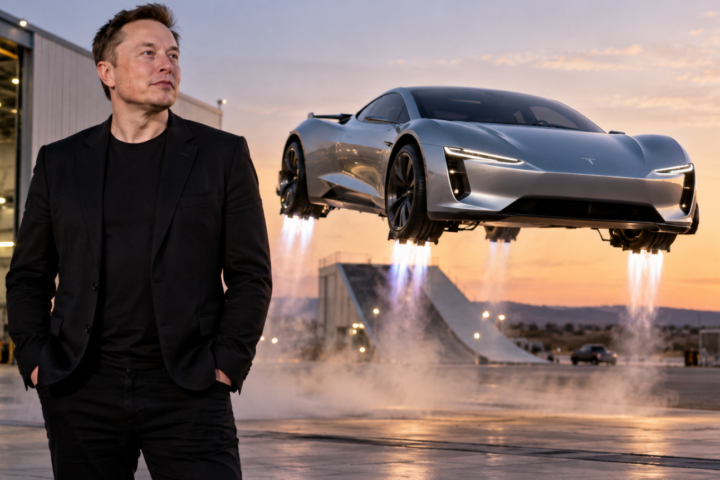
Tesla Inc is advancing a software-first autonomous mobility strategy led by Elon Musk’s aggressive AI-driven transportation vision.
Musk has stated that fully self-driving cars without human supervision could become more widespread in the United States within this year. Tesla already operates autonomous ride-hailing services in cities such as Austin, Dallas, and Houston, although real-world performance continues to face challenges around availability, routing consistency, and regulation.
Despite operational limitations, Tesla’s long-term outlook remains highly expansionary. Musk has projected that AI could eventually handle the majority of global travel distance within the next decade, fundamentally shifting mobility from ownership-based models to on-demand autonomous networks.
China vs US Autonomous Competition
The global autonomous vehicle landscape is now defined by two competing execution frameworks.
XPeng is scaling physical production capacity and embedding autonomy directly into manufacturing pipelines. This creates a hardware-first advantage where deployment can scale alongside industrial output.
Tesla is pursuing a software-first disruption model, aiming to layer intelligence across existing transportation systems and rapidly expand autonomous services through iterative AI deployment.
Both strategies converge toward the same endpoint: AI-native mobility ecosystems that operate continuously without human driving intervention.
Future of AI Transportation Systems
The implications of this robotaxi race 2026 extend far beyond automotive innovation. Autonomous mobility is evolving into a foundational layer of smart city infrastructure, influencing logistics networks, urban planning, and economic productivity models.
Vehicles are no longer being positioned as standalone products. They are becoming connected intelligence nodes within a distributed mobility system that continuously optimizes movement and efficiency.
Regulatory oversight, safety validation, and infrastructure readiness will ultimately determine how quickly this transition scales globally. However, the direction is already clear: transportation is shifting from mechanical control to algorithmic orchestration.
Final Insight
The competition between XPeng and Tesla is not simply a technological race. It is a structural contest over who defines the operating system of future mobility.
XPeng is industrializing autonomy. Tesla is software-optimizing it. Both are converging on the same outcome: a world where driving becomes optional, and AI becomes the default mobility driver.