Every operations leader reaches a point where the software stack that got them here simply cannot take them further. Orders are being tracked in one system, inventory in another, and freight contracts in a spreadsheet. The warehouse management system doesn’t talk to the ERP, and nobody quite knows which number to trust when finance asks for a shipment cost breakdown. This is not a technology failure: it is an architecture failure. And it is more common than most businesses care to admit.
To fix it, you first need to understand what each system actually does, where each one ends, and why the gaps between them are costing you more than you think.
Three Systems, Three Jobs and One Critical Gap
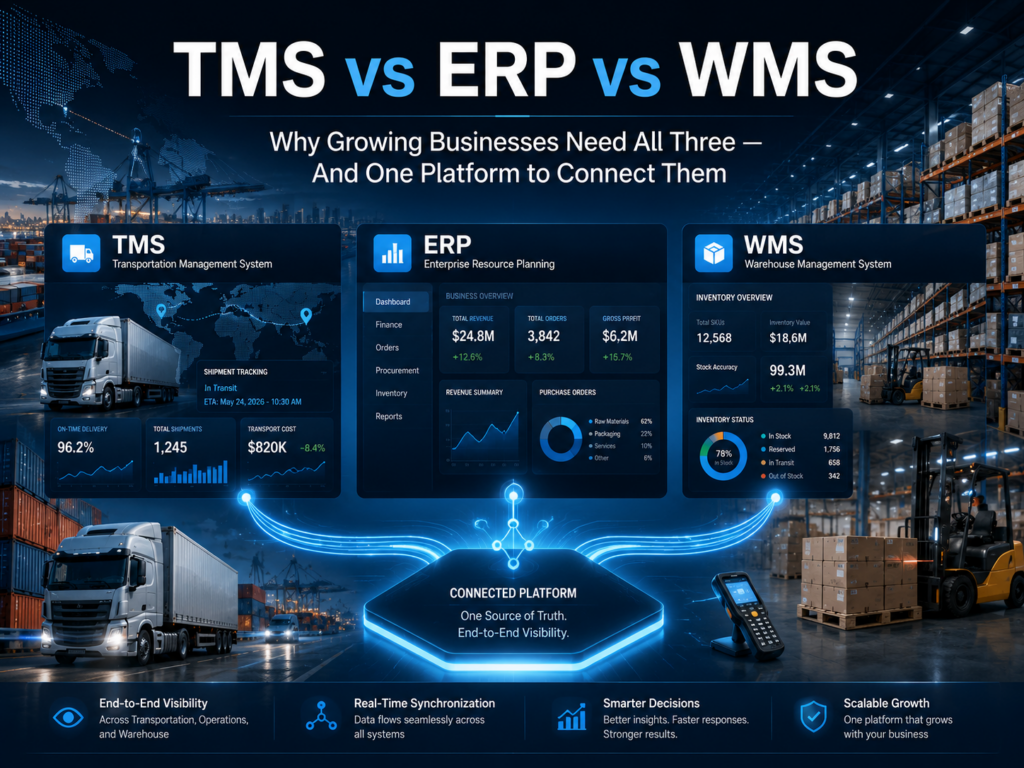
Enterprise Resource Planning (ERP) is the financial and operational backbone of a business. It manages procurement, finance, HR, and inventory planning. It tells you what you have, what you owe, and what you’ve ordered. What it cannot tell you is how that inventory is moving through your warehouse today or whether the truck carrying your most important order is running two hours behind schedule.
Warehouse Management Systems (WMS) fill that operational gap inside the four walls. A good WMS manages bin locations, inbound putaway, pick-and-pack workflows, cycle counting, and outbound dispatch. It knows exactly where every SKU is at any moment within your facility. But the moment that shipment leaves the dock, a traditional WMS goes dark. It has no visibility into what happens on the road.
That is precisely where a Transport Management System (TMS) begins. A TMS governs everything that happens once goods leave the warehouse: carrier selection, route optimisation, freight contracting, compliance documentation, live tracking, proof of delivery, and invoice reconciliation. It is the operational layer that most growing businesses either underinvest in or bolt on as an afterthought, and that decision quietly drains margins every single day.
The gap between these three systems is not a minor inconvenience. It is where delayed shipments hide, where freight overcharges go undetected, where compliance failures occur, and where customer experience quietly deteriorates. Businesses that run disconnected ERP, WMS, and TMS platforms spend enormous human effort simply translating data between systems, effort that produces no operational value and creates significant risk.
Why Integration Is Not Enough and What Unification Looks Like
Many software vendors will tell you the answer is “integration.” Build an API bridge between your ERP and your WMS. Plug your TMS into both. Create a single dashboard that pulls from all three. In theory, this works. In practice, integration creates fragility. Every system update risks breaking the connection. Data latency means decisions are made on information that is already out of date. And when something goes wrong, like a shipment exception, a compliance failure, an invoice dispute, the finger-pointing between systems begins.
The more durable answer is unification: a platform where TMS, WMS, and supply chain intelligence operate as a single system of record, not three systems patched together.
This is the architecture behind Libera’s Transport Management System, a platform built not in a boardroom but forged while running one of India’s largest logistics and fulfilment networks, processing over 5 million shipments daily across 2,400+ warehouses. Libera’s TMS integrates natively with ERP systems, e-commerce platforms, and WMS operations, meaning the data that informs your warehouse operations is the same data driving your decisions, in real time, without translation loss.
What This Means for Growing Businesses
For scale-up businesses, the stakes are particularly high. Every inefficiency that is manageable at 1,000 shipments per day becomes a structural problem at 10,000. Manual carrier selection introduces cost variance. Disconnected compliance tracking creates regulatory exposure. Invoices that cannot be auto-matched to contracts require human review that doesn’t scale.
Libera addresses each of these compounding risks systematically. Its dynamic bidding engine selects vendors based on performance scores and contract rates, eliminating the subjectivity from carrier decisions. Automated invoice generation matches directly to contract terms, removing reconciliation delays. A 10-pointer document verification system checks LR copies, insurance certificates, and e-way bills before departure — making compliance a built-in process rather than a manual checkpoint. And a real-time network control tower provides end-to-end visibility from the warehouse dock to the final delivery, with AI-driven exception handling that identifies and resolves disruptions before they escalate.