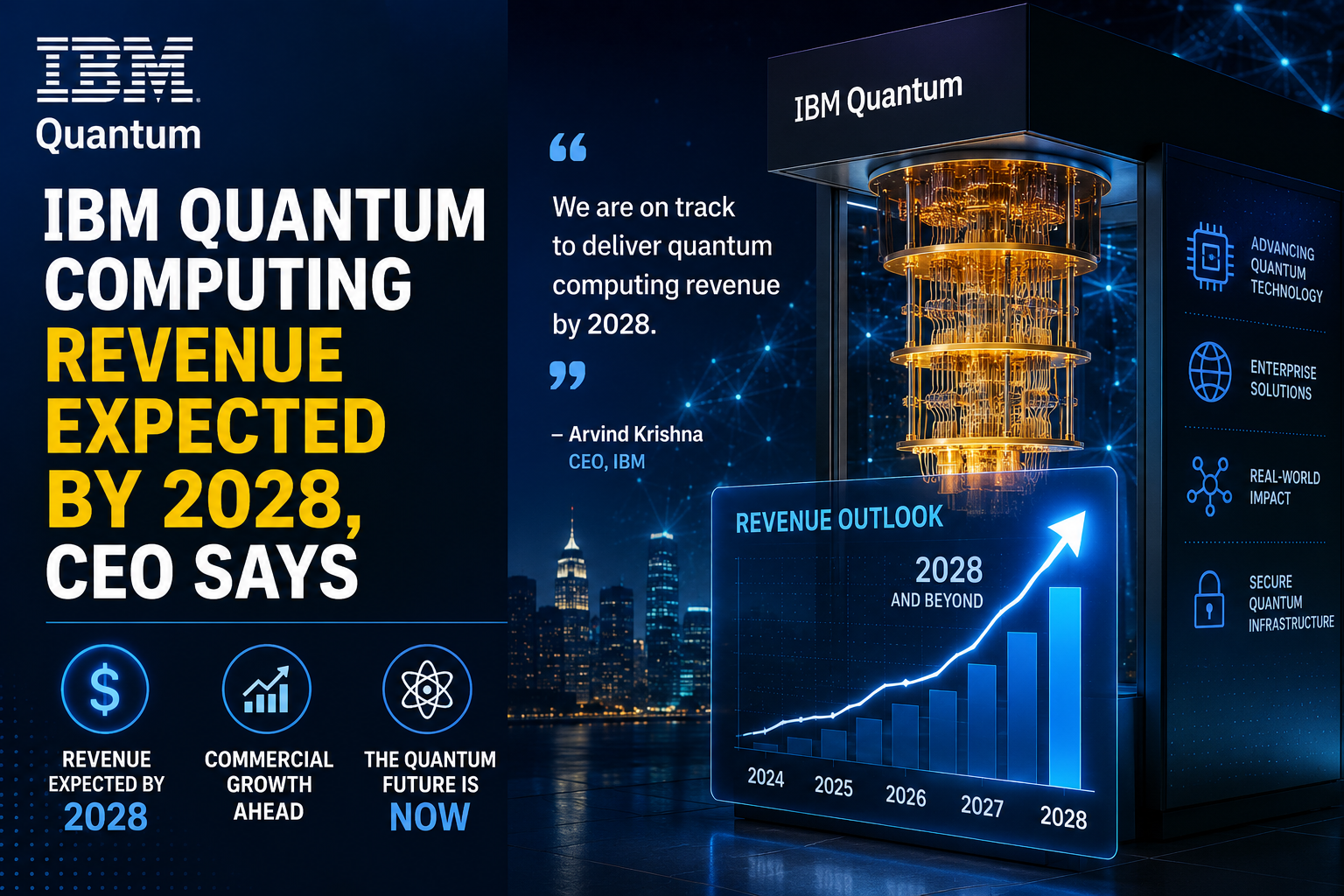
IBM quantum computing revenue is officially on the clock. Chief Executive Officer Arvind Krishna told CNBC that the company expects quantum computing to begin making a measurable impact on earnings by 2028 or 2029, a milestone he said is backed by new research demonstrating the technology’s growing commercial potential.
Speaking on CNBC’s Mad Money, Krishna said IBM believes quantum computing is approaching an inflection point after decades of research and development. His comments followed an announcement from IBM and quantum software startup Algorithmiq describing what they called a quantum advantage milestone, in which a quantum computer completed a specific computational task more efficiently than today’s most powerful classical supercomputers while also verifying that its results were correct.
“I think that in 2028 or 2029, you’ll see it have a measurable impact on our top line and bottom line,” Krishna said. “By the end of the 2030s, we are now pretty convinced this is a trillion dollars of value.”
Table of Contents
IBM Quantum Computing Revenue: A Trillion Dollar Long Term Bet
Krishna’s comments give investors something quantum computing has lacked for years, a specific timeline. Quantum computers use the principles of quantum mechanics to process certain calculations differently than conventional machines, and researchers believe they could eventually tackle problems in chemistry, materials science, and optimization that are impractical for classical systems to solve.
According to Krishna, IBM’s latest research shows quantum computers are already beginning to reveal scientific phenomena that conventional computers have struggled to simulate. “Quantum computer can do things better, faster, cheaper, in a way that normal classical computers cannot do at this time,” he said.
What Quantum Advantage Actually Means
The announcement with Algorithmiq is central to Krishna’s confidence. The companies said they used an error mitigated quantum simulation to demonstrate quantum advantage, meaning the system produced results that were both faster and verifiably accurate compared with classical alternatives. That distinction matters because it shows useful quantum computations are possible even before fully fault tolerant quantum computers become available, a milestone the industry has chased for years.
Krishna pointed to several fields where this kind of capability could eventually pay off, including battery development, new materials, fusion energy, and pharmaceutical research. Each of these areas involves modeling molecular or material behavior at a scale that quickly overwhelms classical computing power.
Investing in a Quantum Chip Foundry
IBM is backing its optimism with capital. In May, the company announced plans to build a standalone quantum chip foundry, supported by a one billion dollar commitment from the U.S. Department of Commerce through the CHIPS incentive program, matched by a further one billion dollar investment from IBM itself. The move mirrors a broader wave of government backed semiconductor investment already reshaping the chip industry, a trend Welp Magazine covered as TSMC posted record revenue on surging AI chip demand.
The foundry is designed to strengthen domestic manufacturing of quantum processors as competition intensifies. IBM faces growing pressure from Google and Rigetti Computing, along with a wave of startups building quantum hardware, software, and supporting technologies. Many of these companies have accelerated investment in quantum error correction, the field focused on reducing the computational errors that still limit how large and reliable quantum systems can become.
The push also lands alongside a broader U.S. policy focus on quantum leadership, including the Trump administration’s quantum executive order aimed at accelerating domestic research and development.
Reading the Stock Dip Correctly
Krishna’s quantum timeline arrives just weeks after IBM’s largest single day stock decline on record, triggered when the company disclosed that several enterprise customers had delayed capital spending decisions. The drop raised questions about near term demand and whether rapid advances in artificial intelligence could pressure parts of IBM’s software business.
Krishna pushed back on the idea that the delays signal deeper trouble. “Here’s the good news, about 40 percent of them have already closed in three to four weeks,” he said. “That’s a good signal that it is a deferral, not a destruction.”
What It Means for the Industry
Taken together, Krishna’s comments frame quantum computing as a technology moving from research curiosity to commercial roadmap. IBM is not alone in racing toward that milestone, but it is among the first major players to attach a specific year and a specific dollar figure to the opportunity. Whether the 2028 timeline holds will depend on continued progress in error rates, qubit counts, and system scale, the same technical hurdles that have defined the field for years.
For now, IBM’s message to investors is straightforward. The deferred deals are coming back, the chip foundry is under construction, and the quantum advantage milestone is evidence the technology is starting to work the way researchers long promised.
Frequently Asked Questions
When does IBM expect quantum computing revenue to become measurable?
CEO Arvind Krishna said quantum computing should have a measurable impact on IBM’s top line and bottom line by 2028 or 2029.
How large could the quantum computing market become for IBM?
Krishna said IBM is now confident quantum computing represents a trillion dollars of value by the end of the 2030s.
What is quantum advantage?
Quantum advantage describes a milestone in which a quantum computer completes a specific task more efficiently than the most powerful classical supercomputers, while also verifying that its results are correct.
Why did IBM stock decline recently?
IBM shares fell sharply after the company disclosed that several enterprise customers had postponed capital spending decisions, raising short term concerns about demand.
Which industries could benefit first from quantum computing?
Krishna pointed to battery development, new materials, fusion energy, and pharmaceutical research as early areas where quantum computing could outperform classical systems.
Stay ahead of the next wave of computing. Follow Welp Magazine’s Technology desk for daily coverage of AI, quantum computing, and the infrastructure powering them.