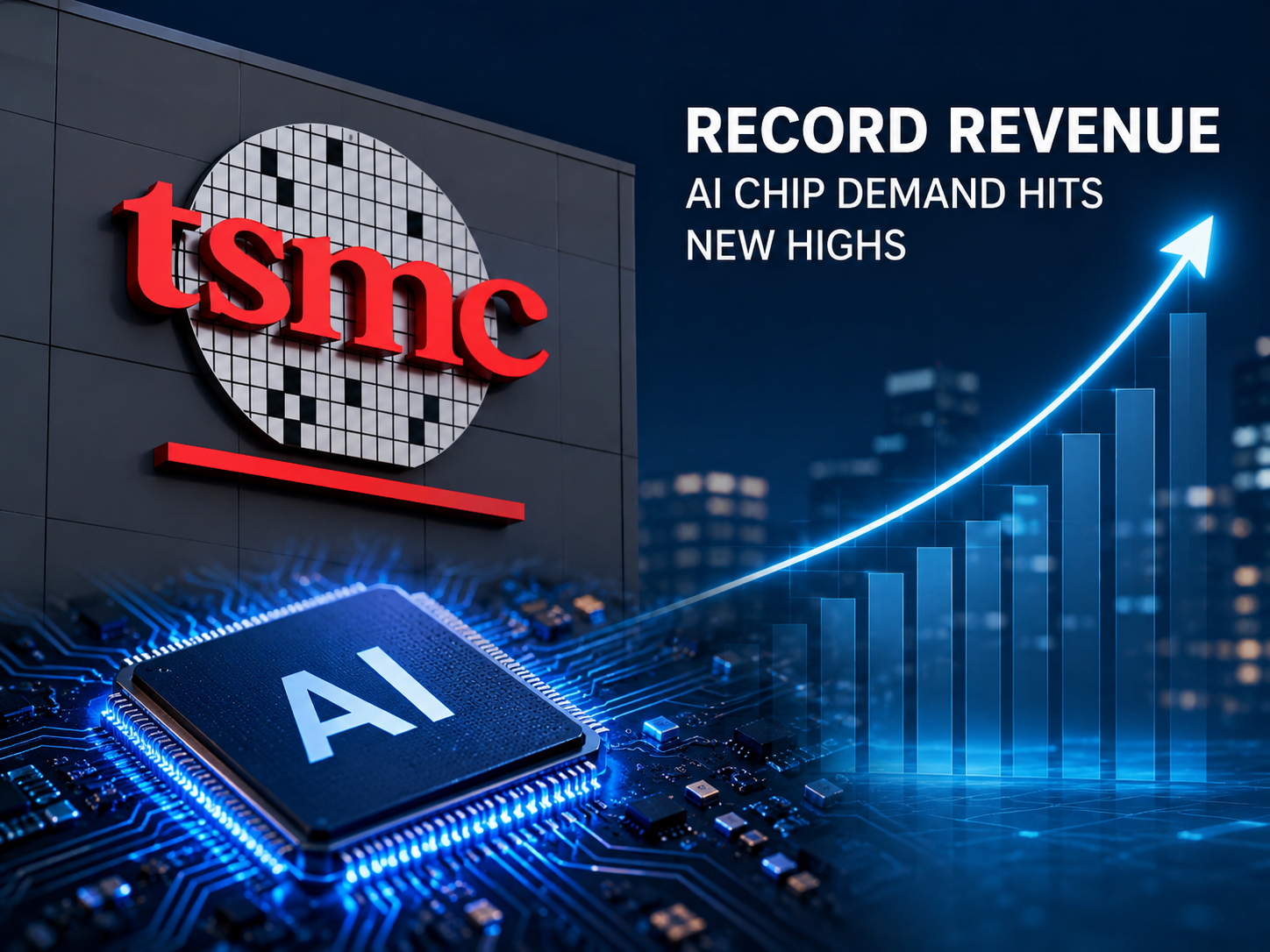
Taiwan Semiconductor Manufacturing Company posted its strongest month of sales in company history in June, driven almost entirely by AI chip demand that shows no sign of slowing. The world’s largest contract chipmaker reported June revenue of roughly NT$442.68 billion (about $13.2 billion), a 67.9% jump from a year earlier, pushing second-quarter revenue to an estimated $39.6 billion — a 36% year-over-year increase that beat the top end of the company’s own guidance range.
The figures, released ahead of TSMC’s full second-quarter earnings report, underline just how central the Taiwanese foundry has become to the global AI buildout. First-half 2026 revenue reached roughly $74.99 billion, a 35.6% increase over the same period last year, according to company filings cited by multiple financial outlets. Executives and analysts point to one overwhelming driver: chipmakers building the processors that power generative AI models simply cannot get enough advanced silicon.
Why the Numbers Are So Big
TSMC’s advanced manufacturing nodes, particularly its 3-nanometer (N3) process, are effectively sold out. That node is used to produce the AI accelerators and high-performance CPUs sold by Nvidia, AMD, Apple, and a growing list of hyperscalers building their own custom silicon. When demand for a single manufacturing process outstrips supply this dramatically, the pricing power and volume both flow toward TSMC, which retains an estimated 60-70% share of the global contract chipmaking market and an even larger share of leading-edge production specifically.
Analysts tracking the semiconductor sector say TSMC is now on pace to generate more than $40 billion in AI-related chip revenue in 2026 alone, or close to a quarter of its total business — a figure that would have been almost unthinkable five years ago, before the generative AI boom reshaped global technology spending.
A Bright Spot Amid a Shaky Chip Market
The revenue surge lands at an unusual moment for chip stocks broadly. Semiconductor shares slid sharply across global markets earlier this week after renewed U.S.-Iran tensions pushed oil prices higher, reviving concerns about inflation, interest rates, and the cost of powering energy-intensive AI data centers. South Korea’s Kospi index saw some of its steepest declines, with memory-chip makers among the hardest hit.
TSMC’s own stock has not been immune to that broader volatility — the Philadelphia Semiconductor Index has shed more than 11% since hitting a record high in June, even though it remains up roughly 83% for the year. But TSMC’s June sales data suggests the underlying demand for AI compute has, for now, kept climbing regardless of what is happening in energy markets or interest-rate policy. That divergence — soft chip-stock sentiment against a backdrop of record chip-company revenue — is becoming one of the more closely watched tensions in the AI infrastructure trade.
What It Means for the Rest of the AI Supply Chain
TSMC’s results matter well beyond Taiwan. Nearly every major AI hardware company depends on TSMC’s fabs to actually build the chips they design. Nvidia’s data-center GPUs, Apple’s custom silicon, AMD’s AI accelerators, and increasingly the custom in-house chips being developed by Meta, Google, Amazon, and Microsoft all rely on TSMC’s advanced nodes in some form. A sold-out N3 process means those companies are competing for allocation, and it gives TSMC significant leverage over pricing and prioritization.
It also reinforces a broader trend playing out across the industry this year: hyperscalers are racing to secure both third-party GPU supply and their own custom silicon, in large part because they cannot get enough advanced manufacturing capacity from any single source. Meta, for instance, is preparing to begin production of its in-house “Iris” AI chip — designed with Broadcom and fabricated by TSMC — in September, as part of a plan to roughly double its computing capacity by 2027. Intel and Samsung are separately pouring billions into expanding their own advanced chip manufacturing in Europe and South Korea, respectively, though neither has yet closed the technological gap with TSMC’s leading-edge nodes.
The Question Investors Are Asking
The central debate among analysts is not whether AI chip demand is real — TSMC’s order book answers that question definitively — but whether it can be sustained at this pace once hyperscalers’ current infrastructure build-outs mature. Some investors worry that the same capital expenditure boom fueling TSMC’s growth could eventually slow if AI monetization doesn’t keep pace with the tens of billions being poured into data centers, power infrastructure, and custom chips. Others point out that TSMC’s guidance and order backlog extend well into 2027, suggesting customers themselves expect demand to hold.
For now, TSMC’s June numbers offer the clearest single data point yet that, whatever happens to AI stock valuations in the short term, the physical demand for advanced chip manufacturing capacity remains extraordinarily tight. The company is expected to detail full second-quarter results, along with updated guidance for the second half of 2026, in its upcoming earnings call.
How TSMC Got Here
TSMC’s dominance did not happen overnight. The company spent much of the past decade investing tens of billions of dollars annually in advanced fabrication capacity, betting that leading-edge manufacturing would remain a scarce, defensible advantage even as chip design became more distributed across the industry. That bet paid off well before the generative AI boom, when TSMC became the near-exclusive manufacturer for Apple’s mobile processors. But the AI era has magnified the payoff considerably, turning what was already the world’s most valuable chip manufacturer into an even more central chokepoint for the entire technology industry.
That centrality comes with geopolitical weight attached. TSMC’s fabs are concentrated in Taiwan, a fact that has pushed the U.S., European Union, Japan, and South Korea to accelerate their own domestic semiconductor investments over the past several years — from Intel’s expansion in Ireland to Samsung’s accelerated South Korean plant timeline. None of those efforts has yet matched TSMC’s yields or scale on the most advanced nodes, which is part of why the company continues to command such outsized pricing power even as governments work to diversify where advanced chips get made.
Separately, China has recently signaled a modest loosening of restrictions on domestic AI companies purchasing certain Nvidia processors, a move that could add yet another layer of demand into an already tight global supply chain, even as Beijing continues investing heavily in homegrown chip alternatives. Whether that shift meaningfully changes TSMC’s order volumes remains to be seen, but it adds another data point to a global picture in which practically every major economy is trying to secure a larger share of advanced chip production or access.
Frequently Asked Questions
Why did TSMC’s revenue surge in June 2026?
TSMC’s June revenue rose 67.9% year-over-year to roughly $13.2 billion, driven primarily by surging AI chip demand. The company’s advanced 3-nanometer manufacturing node is effectively sold out, as chipmakers producing AI accelerators and custom silicon for hyperscalers compete for limited capacity.
How much revenue did TSMC report for the second quarter of 2026?
TSMC’s second-quarter revenue reached an estimated $39.6 billion, a 36% increase year-over-year that beat the top end of the company’s guidance range of $39 billion to $40.2 billion.
Which companies depend on TSMC for AI chip manufacturing?
Nvidia, AMD, Apple, and hyperscalers including Meta, Google, Amazon, and Microsoft all rely on TSMC’s advanced manufacturing nodes to produce AI accelerators, custom silicon, and high-performance processors.
Is TSMC’s AI chip demand expected to continue?
TSMC’s order backlog reportedly extends well into 2027, and the company is projected to generate more than $40 billion in AI-related chip revenue in 2026 alone. Some analysts caution that sustained demand depends on whether AI monetization keeps pace with continued infrastructure spending.
What is TSMC’s market share in advanced chip manufacturing?
TSMC holds an estimated 60-70% share of the global contract chipmaking market overall, with an even larger share of production on the most advanced nodes used for AI chips.