All Eyes Are on Jensen Huang at GTC Taipei. Here Is the NVIDIA Story You Probably Missed.
The world is watching NVIDIA’s GTC Taipei keynote this week. Everyone is waiting for the next GPU announcement, the next AI infrastructure bombshell, the next Jensen Huang moment.
But while the hype machine points at Taipei, there is a quieter NVIDIA launch from six weeks ago that most people completely slept on.
It is called Ising. And it might be the most important thing NVIDIA has released in 2026 that nobody is talking about.
Here is why quantum computing just changed forever.
What Is NVIDIA Ising?
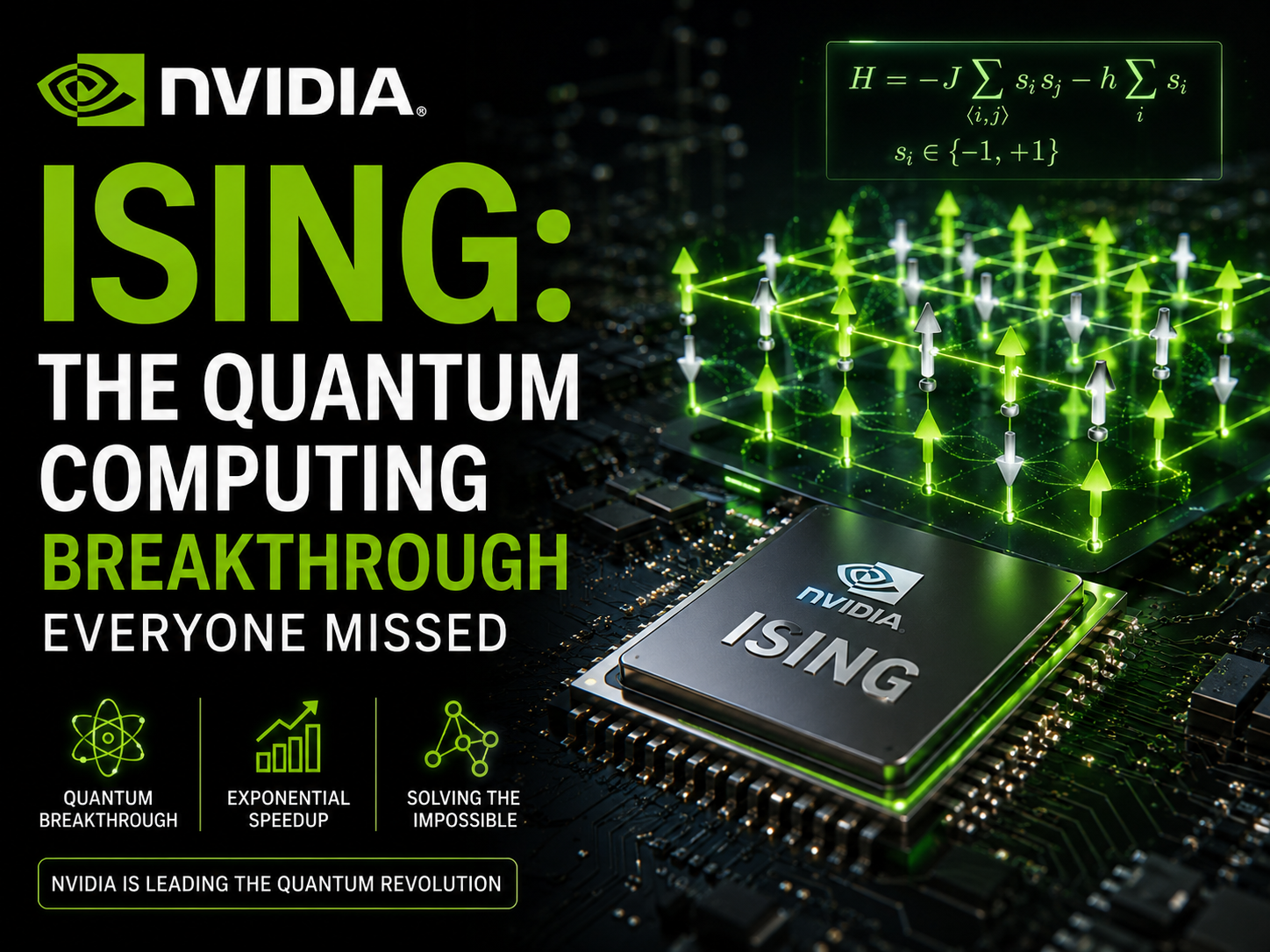
NVIDIA Ising is the world’s first open-source family of AI models built specifically for quantum computing. Launched on April 14, 2026, Ising targets the two hardest unsolved problems in quantum computing: calibration and error correction.
Named after the Ising mathematical model that simplified how physicists understand complex systems, NVIDIA’s Ising does the same for quantum hardware. It gives researchers and enterprises a production-ready AI toolkit to build quantum processors that actually work at scale.
These are not prototype models. They are already deployed at Harvard, IonQ, Fermi National Accelerator Laboratory, Lawrence Berkeley National Laboratory, the UK National Physical Laboratory, and over a dozen other leading quantum institutions worldwide.
Why Quantum Computing Has Been Stuck
To understand why Ising matters, you need to understand the wall quantum computing has been hitting for years.
Quantum processors use qubits instead of classical bits. Qubits are extraordinarily sensitive to environmental interference. They break. They drift. They produce errors at a rate that makes running reliable applications almost impossible at scale.
Two problems sit at the core of this:
Calibration is the process of tuning a quantum processor so it performs reliably. It requires interpreting enormous volumes of experimental data and making precise adjustments to how the processor operates. Until now, this took days of manual expert work every single time.
Error correction is the real-time process of detecting and fixing qubit errors while a quantum program is running. It requires processing terabytes of measurement data thousands of times per second. The computational demand is so extreme that even the best classical algorithms struggle to keep up.
AI solves both. NVIDIA Ising is how.
NVIDIA Ising Calibration: Days of Work Reduced to Hours
Ising Calibration is a 35 billion parameter Vision Language Model fine-tuned to read experimental data from quantum processors and automatically determine the correct calibration actions.
It outperforms every other known approach across a suite of six independent benchmark tests. Working with an AI agent, it fully automates the calibration process, cutting what previously took days down to hours.
For quantum hardware companies, this is transformational. Continuous calibration is one of the biggest operational bottlenecks in running a quantum processor at commercial scale. Automating it with a model this accurate removes an entire category of engineering overhead.
NVIDIA Ising Decoding: 2.5x Faster, 3x More Accurate
Ising Decoding is a pair of 3D convolutional neural network models, one optimised for speed and one for accuracy, designed to perform real-time decoding for quantum error correction.
The benchmark numbers are significant. Ising Decoding delivers up to 2.5 times faster performance and 3 times higher accuracy compared to pyMatching, the current open-source industry standard for quantum error correction decoding.
For fault-tolerant quantum computing to work, decoding has to happen faster than errors accumulate. Ising Decoding clears that bar. It processes surface codes of any distance and ships with a training framework built on PyTorch and CUDA-Q, making it adaptable to any noise model a researcher needs to work with.
The Ecosystem Already Building on Ising
The adoption list is not a wishlist. These institutions are already running Ising in active quantum computing development.
Ising Calibration is live at Atom Computing, Academia Sinica, EeroQ, Conductor Quantum, Fermi National Accelerator Laboratory, Harvard John A. Paulson School of Engineering and Applied Sciences, Infleqtion, IonQ, IQM Quantum Computers, Lawrence Berkeley National Laboratory’s Advanced Quantum Testbed, Q-CTRL, and the UK National Physical Laboratory.
Ising Decoding is deployed at Cornell University, EdenCode, Infleqtion, IQM Quantum Computers, Quantum Elements, Sandia National Laboratories, SEEQC, UC San Diego, UC Santa Barbara, University of Chicago, University of Southern California, and Yonsei University.
When institutions at this level adopt a tool this fast, it signals something real.
How NVIDIA Ising Fits the Bigger Platform
Ising does not sit in isolation. It integrates directly with NVIDIA’s full quantum-GPU supercomputing stack.
CUDA-Q is NVIDIA’s software platform for hybrid quantum-classical computing. NVQLink is the hardware interconnect that bridges quantum processors with NVIDIA GPUs for real-time control and error correction. Ising sits on top of both, providing the AI layer that makes the entire system intelligent and self-correcting.
NVIDIA also ships Ising with NIM microservices for instant deployment and a full cookbook of quantum computing workflows, giving researchers a clear path to fine-tune models on their own hardware using proprietary data without sending anything to an external server.
Jensen Huang described it directly: AI becomes the control plane. The operating system of quantum machines.
The Market Opportunity
The global quantum computing market is projected to surpass $11 billion by 2030 according to analyst firm Resonance. That trajectory depends entirely on progress in error correction and scalability. Both are now significantly closer to solved.
NVIDIA is positioning itself as the infrastructure layer for quantum computing the same way it became the infrastructure layer for AI. Ising is the opening move in that strategy. Open source, widely adopted, deeply integrated with NVIDIA hardware, and impossible to replicate quickly.
The companies and research labs building on Ising today are building on the platform that will define the quantum computing industry for the next decade.
What Makes NVIDIA Ising Different from Everything Before
Three things separate Ising from prior attempts at AI for quantum computing.
First, performance. The benchmark results against established baselines are not marginal improvements. Outperforming every calibration approach across six tests and delivering 3x accuracy gains in decoding are step-change results.
Second, openness. Ising is released with permissive licensing, full documentation of training methods, data provenance, and tools to fine-tune and quantize the models. Developers can retrain for their own hardware. Proprietary data stays local.
Third, integration. Ising connects directly with NVIDIA’s existing quantum hardware and software stack. It is not a standalone research tool. It is a production component designed to run inside real quantum computing systems.
Frequently Asked Questions
What is NVIDIA Ising? NVIDIA Ising is the world’s first open-source family of AI models designed for quantum computing. It includes two main models: Ising Calibration for automating quantum processor tuning and Ising Decoding for real-time quantum error correction.
When was NVIDIA Ising launched? NVIDIA Ising was officially launched on April 14, 2026.
How does NVIDIA Ising improve quantum error correction? Ising Decoding delivers up to 2.5 times faster performance and 3 times higher accuracy than pyMatching, the current open-source industry standard for quantum error correction decoding.
Who is using NVIDIA Ising? Leading institutions including Harvard, IonQ, Fermi National Accelerator Laboratory, Lawrence Berkeley National Laboratory, Cornell University, Sandia National Laboratories, and the UK National Physical Laboratory are among the early adopters.
Is NVIDIA Ising free to use? Yes. NVIDIA Ising is open source with permissive licensing and includes training data, documentation, and tools for fine-tuning and deployment at no cost.
How does NVIDIA Ising connect with existing quantum hardware? Ising integrates with NVIDIA’s CUDA-Q software platform and NVQLink hardware interconnect, providing a full quantum-GPU supercomputing stack.
What is the quantum computing market size? The global quantum computing market is projected to exceed $11 billion by 2030, with growth heavily dependent on advances in error correction and calibration that NVIDIA Ising directly addresses.
Explore NVIDIA Ising: https://www.nvidia.com/en-in/solutions/quantum-computing/ising/
For the latest in AI, emerging technology, and innovation that actually matters, visit Welp Magazine