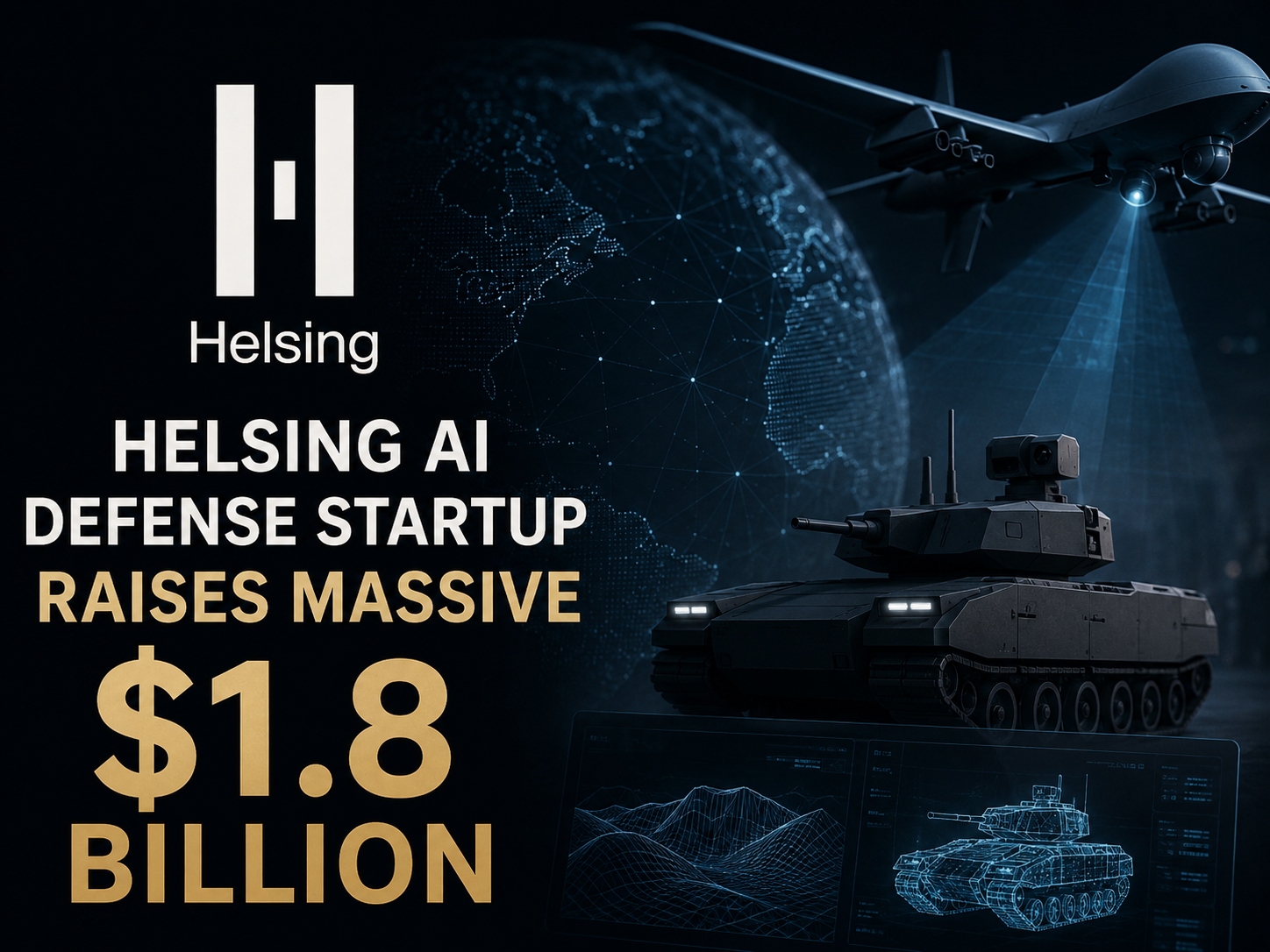
Europe just handed its biggest defense check yet to a company that did not exist five years ago. The Helsing AI defense startup has closed a 1.8 billion dollar funding round at an 18 billion dollar valuation, making it the most valuable defense technology company the continent has ever produced.
Investor demand for the round reportedly outstripped the amount Helsing was actually raising. That alone tells you where smart money thinks the next decade of European security spending is headed, and why the Helsing AI defense startup has become the name every European security investor now wants exposure to.
Table of Contents
At a Glance
- The Helsing AI defense startup raised 1.8 billion dollars in a Series E round, valuing the company at 18 billion dollars.
- Lead backers include Dragoneer, Lightspeed, Goldman Sachs Alternatives, JPMorgan Chase, and the Canada Pension Plan Investment Board.
- The company builds AI strike drones, an autonomous jet aircraft, underwater surveillance drones, and electronic warfare software for European militaries.
- Ukraine has been the proving ground for much of Helsing’s hardware, including thousands of strike drones already under contract.
- Helsing was valued at roughly 12 billion dollars a year ago, meaning its worth has grown nearly fourfold in two years.
What the Helsing AI Defense Startup Just Raised
The Series E round brought in a heavyweight investor list: Dragoneer Investment Group, Lightspeed Venture Partners, Disruptive, Iconiq, the growth equity arm of Goldman Sachs Alternatives, JPMorgan Chase, the Canada Pension Plan Investment Board, General Catalyst, Plural, and Stepstone. Several backed earlier rounds and chose to increase their stakes rather than let new money dilute their position.
A year ago Helsing was valued at roughly 12 billion dollars after a 694 million dollar Series D round led by Spotify founder Daniel Ek’s investment firm, Prima Materia. Before that, a Series C round in July 2024 valued the company at about 5 billion dollars. In two years, the Helsing AI defense startup has nearly quadrupled its valuation, a pace that is rare even by AI industry standards.
The company was founded in 2021 by Torsten Reil, Gundbert Scherf, and Niklas Kohler, who set out to build a defense company native to software rather than one bolted onto legacy hardware manufacturing. Four years later, that founding team of three has built one of the most closely watched companies in European defense.
Inside Helsing’s Technology
What actually justifies an 18 billion dollar price tag? For the Helsing AI defense startup, it comes down to a small stack of products built to move faster than a human operator ever could. At the center of it all is Altra, an AI powered operating system built for the battlefield. Altra pulls in sensor feeds from drones, radar, electronic warfare tools, and ground units, then fuses everything into a single real time picture that human commanders can act on faster than any manual process allows.
Helsing’s strike drones use AI and stored map data to navigate and hit targets without relying on GPS, which makes them harder to jam or spoof. Ukraine has become the biggest customer for this hardware, with a contract for 4,000 units placed back in September 2024.
The company’s most ambitious build is an autonomous jet aircraft measuring 36 feet long with a maximum takeoff weight of four tons. Its flight software, called Centaur, was tested last year flying an actual fighter jet over the Baltic Sea with no human pilot at the controls.
Rounding out the lineup is a swarm capable underwater drone built for long term maritime surveillance, plus an electronic warfare system that helps fighter jets detect radar threats actively trying to hide their own signature.
Why Ukraine Keeps Showing Up in This Story
Much of Helsing’s credibility comes from a battlefield no lab could ever simulate. Reports describe a German factory now mass producing strike drones specifically to keep pace with Ukrainian demand.
That kind of combat tested track record is rare for a four year old company, and it is a major reason investors are willing to pay a premium that most young software companies could never justify.
Europe’s Bigger Bet on Defense AI
Helsing’s raise lands at a moment when governments everywhere are pouring money into AI hardware, not just AI software. China is racing to scale up humanoid robot factories, and Japan has committed a trillion yen to robots meant to prop up its shrinking workforce. Europe’s version of that race is happening in defense, and the Helsing AI defense startup is currently its biggest bet.
Germany alone has sharply increased its defense spending in recent years, part of a broader European push toward what officials call technological sovereignty: building weapons, chips, and software domestically instead of depending on outside suppliers.
Governments are also leaning on AI companies for security work closer to home. In the United States, the White House has been evaluating Anthropic’s Claude Mythos AI for cybersecurity use, a sign that defense minded AI deployment is no longer limited to European battlefields.
None of this runs without hardware underneath it. Companies like Elon Musk’s Terafab are racing to build the AI chips that autonomous systems like Helsing’s aircraft depend on to process sensor data in real time.
The autonomy problem Helsing is solving for military aircraft is not unlike the one playing out in the robotaxi race between XPeng and Tesla, just with far higher stakes attached to every decision the software makes.
The Ethical Debate Around Autonomous Weapons
Not everyone is comfortable with software making battlefield decisions at machine speed. Critics argue that removing humans from key decision loops raises hard questions about accountability when something goes wrong.
Helsing says its systems keep a human in the loop for lethal decisions, though the company has not published detailed technical proof of how that works across every product it sells.
The debate is unlikely to slow the funding down. European governments increasing their own defense budgets after years of leaning on NATO and American security guarantees are the same governments now writing checks to companies like Helsing.
Supporters counter that the Helsing AI defense startup is simply catching up to a reality that already exists on modern battlefields, where drones and jamming resistant systems are becoming standard equipment regardless of who builds them.
What Comes Next
Helsing has not detailed exactly how it plans to spend the new 1.8 billion dollars, but scaling drone and aircraft production, expanding Centaur’s software capabilities, and growing beyond Germany and Ukraine are the likely priorities.
The bigger test is whether a four year old company can keep multiplying its valuation once it moves from urgent wartime orders to the slower, more bureaucratic procurement cycles that define most defense budgets in peacetime.
Analysts tracking European defense technology say the next real test for the Helsing AI defense startup is exporting beyond its home base, since most of its combat proven products have so far been built and used within Germany and Ukraine specifically.
How This Was Reported
This story draws on funding and valuation details first reported by CNBC and Axios, with additional investor and round detail from TechFundingNews. Figures were cross checked across all three sources before publication, and the Helsing AI defense startup has not publicly disputed any of the numbers reported.
Frequently Asked Questions
What does the Helsing AI defense startup actually do?
Helsing builds AI software and autonomous hardware for European militaries, including strike drones, an autonomous jet aircraft, underwater surveillance drones, and electronic warfare systems.
How much did Helsing raise in its Series E round?
Helsing raised 1.8 billion dollars in its Series E round, valuing the company at 18 billion dollars.
Who invested in Helsing’s latest funding round?
Investors included Dragoneer Investment Group, Lightspeed Venture Partners, Disruptive, Iconiq, Goldman Sachs Alternatives, JPMorgan Chase, the Canada Pension Plan Investment Board, General Catalyst, Plural, and Stepstone.
What is Helsing’s autonomous jet aircraft?
Helsing’s flagship aircraft is powered by its Centaur flight software, which was tested flying a fighter jet over the Baltic Sea with no human pilot on board.
Why is Ukraine important to Helsing’s growth?
Ukraine has contracted thousands of Helsing’s strike drones, giving the company real combat data and credibility that few young defense startups can match.
What was Helsing’s valuation before this round?
Helsing was valued at roughly 12 billion dollars after its Series D round in June 2025, up from about 5 billion dollars after its Series C round in July 2024.
Want more breakdowns of the funding rounds and AI hardware shaping global defense and robotics? Follow Welp Magazine for daily coverage of the deals moving fastest.