What if your next video consultation could involve an assistant that listens carefully, watches for important signs, asks the questions you forgot to mention, and helps build a picture of what might be wrong?
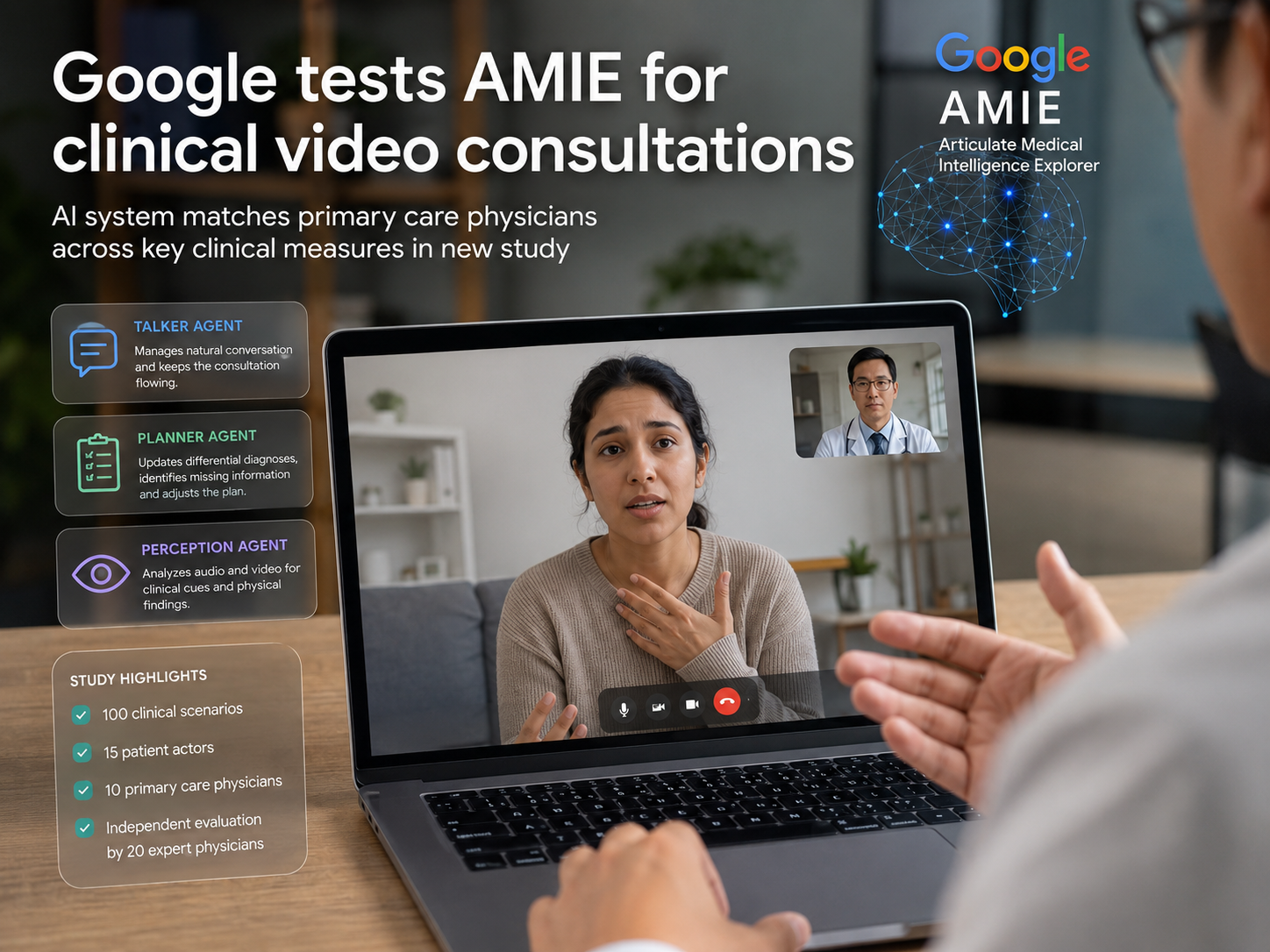
That is the direction Google is exploring with Google AMIE, its medical research system built on Gemini and Project Astra. In a new study, Google tested AMIE in live video consultations with trained patient actors.
The results were striking. Independent doctors evaluating the sessions rated AMIE around the same level as primary care physicians on several important measures, including taking medical histories, identifying possible diagnoses, recommending treatment and communicating with patients.
But there is an important catch. This is promising research, not a digital doctor ready to replace your physician. And that distinction could be the most important part of the story.
Table of Contents
Google Wants AMIE to See and Hear, Not Just Read
Most medical chatbots work through text. You type your symptoms. The system responds. You provide more information. It asks another question. Real medicine is rarely that simple.
Doctors listen to how patients describe their symptoms. They notice changes in voice. They watch movement. They ask patients to perform simple actions. They pick up on details that may never appear in a written message.
Google AMIE research attempts to bring some of that experience into a video consultation. The system can process spoken conversation alongside visual and auditory information, giving it a much broader picture of what is happening during the appointment.
That is a major step beyond the typical type your symptoms into a chatbot experience common in most healthcare AI tools today.
Three Parts of Google AMIE Work Behind the Scenes
Google built AMIE around several specialised components rather than asking one system to do everything at once.
The Talker Keeps the Conversation Moving
The first component handles the actual conversation. It speaks with the patient, responds to questions and keeps the consultation moving naturally. That sounds simple, but it solves a surprisingly difficult problem.
Medical reasoning can take time. Patients do not want to sit through long stretches of silence while a system works through a complicated diagnosis. The conversational component keeps talking while the heavier reasoning happens in the background.
The Planner Thinks Ahead
Behind the conversation, another component continually works through the clinical picture. It considers possible diagnoses, identifies information that is still missing and adjusts the consultation as new details emerge.
In other words, it is not simply answering one question at a time. It is trying to understand where the consultation needs to go next.
The Perception System Watches and Listens
The third component focuses on what can be observed. It processes audio and video information and looks for signs that could be relevant to the consultation, such as physical movements, visible symptoms or sounds that could provide additional context.
This is where AI video consultations become particularly interesting. A patient description of a symptom is one source of information. Seeing and hearing the patient can provide another.
Google Put AMIE Head-to-Head With Doctors
The researchers did not simply ask AMIE a series of medical questions and declare victory. They created simulated clinical consultations using trained patient actors.
The study covered five broad areas of medicine, including cardiopulmonary, abdominal, neurological or psychiatric, HEENT and musculoskeletal conditions. AMIE Video was compared with a text-based version of AMIE and with primary care physicians conducting video consultations, and an independent group of experienced physicians then reviewed the sessions.
Evaluators rated AMIE competitively with the physician group for thoroughness of medical history-taking, diagnostic accuracy, treatment and management recommendations, communication quality, and clinical reasoning.
The video version also performed better than the text-only version in several areas. One particularly interesting finding involved physical examination guidance. AMIE Video was rated strongly for identifying physical signs and helping patients perform virtual examination manoeuvres, which could prove valuable as virtual healthcare continues to expand.
Patients Also Preferred the Video Experience
The study was not only about what doctors thought. The patient actors also evaluated the consultations. Google reported that participants generally preferred the video experience over text chat.
They found it easier to communicate their health concerns and rated AMIE positively for qualities such as empathy, rapport and confidence in the care experience.
That matters because healthcare is not simply about getting the diagnosis right. Patients need to feel heard. A technically impressive system that makes people uncomfortable, confused or ignored will struggle to gain acceptance.
But Here Is Where the Hype Needs to Stop
The results are impressive. They are also easy to overstate. The people involved in the consultations were trained actors following prepared clinical scenarios rather than the unpredictable combination of symptoms, medications, medical history and personal circumstances that real patients bring into a doctor office.
That difference is enormous. A controlled test can tell researchers whether a system performs well under specific conditions. It cannot prove that the same system will behave safely when everything becomes messy, and real healthcare is messy.
Patients forget information. Symptoms overlap. People describe pain differently. Multiple conditions can exist at the same time. Internet connections fail. Background noise interferes with conversations. Sometimes the most important clue is something nobody expected.
Google own research, detailed in a post on the official Google blog, acknowledges that more work is needed before conclusions can be drawn about clinical use with real patients.
The Real Challenge Is Not the Demo
Getting an AI system to perform impressively in a research environment is one thing. Putting it in front of millions of patients is another.
Before a system like AMIE could become a mainstream clinical tool, healthcare organizations would need answers to difficult questions. Who is responsible if it gets something wrong. How is patient data protected. How does the system perform across different populations and accents. What happens when the patient has an unusual condition. When should a human doctor take over. Can every recommendation be reviewed and traced.
These questions could ultimately matter more than whether an AI system can outperform a doctor in a controlled test. For a look at how another major lab is approaching AI infrastructure and reliability, see this piece on the OpenAI GPT-5.5 launch.
The Future May Be AI-Assisted, Not AI-Run
The biggest opportunity for AMIE may not be replacing doctors at all. It could be helping them.
Imagine starting a virtual appointment where an AI assistant gathers the patient history, identifies missing information, listens for relevant symptoms and prepares a structured summary before the physician joins. The doctor could then spend less time collecting basic information and more time making decisions, explaining options and caring for the patient.
That is a much more realistic vision of where healthcare AI could create value. It also makes the technology easier to govern. Instead of handing the entire consultation to a machine, healthcare providers can keep a human clinician responsible for the final decision.
Why Google AMIE Matters Beyond Google
Google research points to a much bigger shift taking place in healthcare technology. The next generation of medical AI systems will not simply read text. They will increasingly combine language, sound, images and video to understand what is happening during an interaction, similar in spirit to how Gemini Spark is reshaping how Google Search itself handles complex queries.
That could transform telemedicine. A remote consultation today can sometimes feel like a watered-down version of an in-person appointment. Systems capable of understanding more than typed symptoms could eventually narrow that gap.
But the industry should resist the temptation to rush. Healthcare is one area where move fast and break things is the wrong strategy. A bad recommendation in a shopping chatbot is inconvenient. A bad recommendation in healthcare can change someone life. This is a very different risk profile than something like other emerging health and wellness technologies aimed at consumers.
Google AMIE Next Test Will Be the Real World
The latest results give Google a strong research foundation. They show that AMIE can participate in structured video consultations and perform impressively against established clinical benchmarks.
But the real test has not happened yet. That test involves ordinary patients, unpredictable symptoms, complicated medical histories and real clinical consequences.
Google is already exploring AMIE in clinical settings through research involving its text-based system, including work with healthcare partners such as Beth Israel Deaconess Medical Center and an ongoing study with Included Health. Similar caution applies broadly across medical AI, including efforts like the Insilico Medicine AI drug program now reaching late stage trials.
If future studies demonstrate that the technology can remain safe, reliable and useful outside controlled scenarios, AMIE could become much more than an impressive research project. It could become a new layer in virtual healthcare.
The Bottom Line
Google AMIE is not replacing your doctor tomorrow. But it is showing where the technology could be heading.
The most interesting part is not that Google built a system that can talk about medicine. It is that the system is learning to listen, watch, reason and interact during the same consultation. That changes the game for virtual healthcare.
The question now is not whether AI can hold a medical conversation. The bigger question is whether it can earn enough trust to become part of the medical team. That answer will only come when AMIE moves from carefully controlled actors to the unpredictability of real patients.
For more coverage on how the biggest labs are shaping the future of AI, check out our ongoing reporting on Google AI hardware and software launches at Welp Magazine.