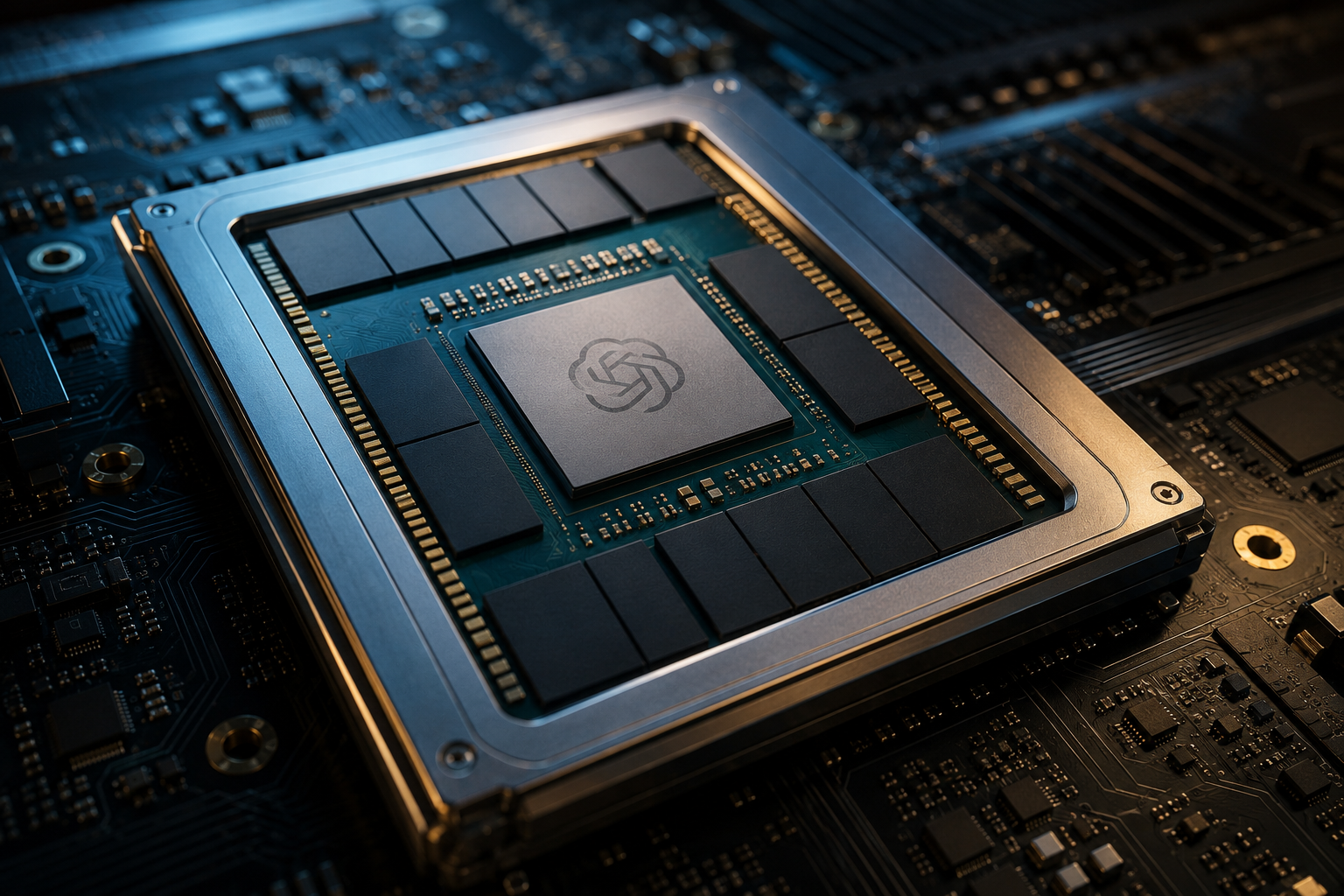
Artificial intelligence has entered a new phase where building smarter models is no longer enough. The real challenge is running those models efficiently at a global scale.
For years, Nvidia’s GPUs have been the engine behind the AI boom, powering everything from ChatGPT to autonomous vehicles. They remain the industry’s gold standard for training large language models. But as AI adoption accelerates, simply purchasing more GPUs has become an increasingly expensive strategy.
That’s why OpenAI took an unexpected step.
Instead of relying entirely on third-party hardware, the company introduced Jalapeño, its first custom AI processor built specifically for large language model inference. It’s a move that isn’t just about designing a faster chip. It’s about reshaping the economics of artificial intelligence.
By developing hardware tailored to its own models, OpenAI hopes to reduce infrastructure costs, improve performance, and gain greater control over the technology powering the next generation of AI.
AI’s Biggest Challenge Isn’t Intelligence. It’s Infrastructure.
Most people experience AI through a simple chat window.
Behind every response, however, lies a massive network of servers processing billions of calculations in real time. Every prompt sent to ChatGPT consumes computing power, memory bandwidth, networking capacity, and electricity.
Now imagine repeating that process hundreds of millions of times every week.
As ChatGPT’s user base continues to grow, the cost of keeping those models online has become one of OpenAI’s biggest business challenges. Training advanced AI models is expensive, but serving them continuously to millions of users is where operational costs quickly multiply.
That reality is forcing AI companies to rethink the infrastructure behind their products rather than simply expanding existing hardware deployments.
Why Didn’t OpenAI Just Buy More GPUs?
At first glance, the obvious solution would be to buy more Nvidia GPUs.
After all, they already power most of today’s AI breakthroughs and continue to deliver exceptional performance for training complex models.
But OpenAI isn’t trying to solve yesterday’s problem.
The company’s biggest expense isn’t building a model once. It’s serving billions of AI responses every single day.
General-purpose GPUs are designed to support many different computing workloads. ChatGPT, however, performs one task repeatedly: running large language model inference as quickly and efficiently as possible.
That distinction matters.
Every unnecessary memory transfer, networking delay, or extra watt of electricity increases operating costs. At OpenAI’s scale, even small improvements in efficiency can save enormous amounts of money over time.
Instead of adapting its software to commercially available processors, OpenAI decided to reverse the equation by building hardware around its own software.
What Makes the Jalapeño Chip Different?
Unlike conventional AI accelerators, the OpenAI Jalapeño chip was engineered specifically for inference, the stage where trained models generate answers for users.
Rather than optimizing for every possible AI workload, Jalapeño focuses on the one workload OpenAI performs more than any other.
That specialization allows the company to balance computing power, memory architecture, and networking more efficiently than a general-purpose GPU.
OpenAI partnered with Broadcom to develop the chip’s architecture while TSMC manufactures the silicon using advanced semiconductor technology. Celestica assembles the boards and rack systems that integrate the processors into large-scale data centres.
Together, these components create an infrastructure optimized for OpenAI’s own models instead of generic AI applications.
More Than a Chip. A New Infrastructure Strategy.
Jalapeño represents a much larger strategic shift than most hardware launches.
Historically, OpenAI focused almost entirely on developing increasingly capable AI models while relying on external partners for the computing infrastructure that powered them.
That model is changing.
Today, OpenAI is investing across every layer of the AI stack, from processor architecture and networking to software optimization and cloud deployment.
By controlling more of its infrastructure, the company can improve efficiency across the entire system instead of optimizing individual components in isolation.
The approach closely resembles Apple’s strategy of designing both hardware and software together, allowing every layer to work in harmony.
Why This Matters for Nvidia
The arrival of Jalapeño doesn’t signal the end of Nvidia’s dominance.
Training frontier AI models will continue to depend heavily on powerful GPU clusters, and Nvidia remains the industry’s leading supplier of AI accelerators.
Instead, Jalapeño addresses a different challenge.
Inference has become one of the fastest-growing costs in artificial intelligence, and custom processors can perform that workload more efficiently than hardware designed for multiple purposes.
Rather than replacing Nvidia, OpenAI is diversifying its infrastructure while reducing long-term dependence on a single supplier.
It’s a strategic move that strengthens OpenAI’s position as demand for AI computing continues to outpace global chip supply.
A New Race Is Emerging
OpenAI isn’t alone.
Google has spent years developing its Tensor Processing Units. Amazon continues expanding its Trainium and Inferentia chips. Microsoft and Meta are investing heavily in their own silicon as well.
The AI race is no longer defined solely by who builds the smartest model.
Increasingly, it’s becoming a competition over who owns the infrastructure capable of delivering those models faster, cheaper, and at a global scale.
Custom silicon is quickly becoming a competitive advantage rather than an engineering experiment.
Final Thoughts
The OpenAI Jalapeño chip is far more than a new processor.
It represents a long-term strategy to reduce costs, improve efficiency, and gain greater control over the technology that powers artificial intelligence.
As AI becomes deeply embedded across industries, the companies that own both their software and hardware may ultimately have the greatest advantage.
For OpenAI, building Jalapeño wasn’t about replacing Nvidia.
It was about ensuring the future of AI isn’t limited by the cost of the hardware that runs it.
FAQs
What is the OpenAI Jalapeño chip?
The OpenAI Jalapeño chip is the company’s first custom AI processor designed specifically to run large language model inference more efficiently.
Why did OpenAI build its own AI chip?
OpenAI developed Jalapeño to lower infrastructure costs, improve inference performance, and reduce dependence on third-party hardware.
Does Jalapeño replace Nvidia GPUs?
No. Nvidia GPUs remain essential for training large AI models. Jalapeño is designed primarily to optimize inference workloads.
Who manufactures the Jalapeño chip?
OpenAI designed the processor with Broadcom, while TSMC manufactures the chips and Celestica builds the supporting server hardware.
The future of AI won’t be built by software alone. It’s being shaped by the chips, infrastructure, and engineering decisions happening behind the scenes today.
Explore more in-depth technology, AI, and business insights on Welp Magazine and stay ahead of the innovations transforming the future of enterprise computing.