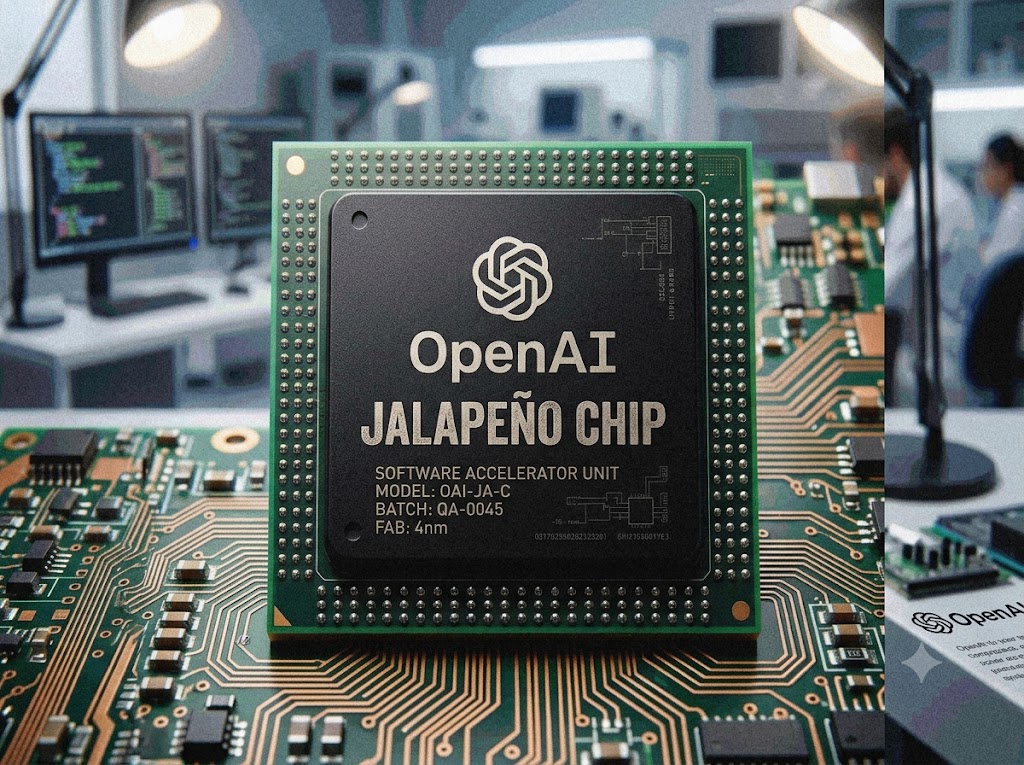
OpenAI has published its first OpenAI Jalapeño chip benchmark results, and the numbers are turning heads across the semiconductor industry. The company says its custom inference processor now beats Nvidia Blackwell systems on several performance measures, and the timing lines up almost exactly with Nvidia preparing to report quarterly earnings. For a company that spent years buying nearly all of its computing power from outside chipmakers, publishing head to head numbers against its biggest supplier is a notable shift.
Table of Contents
What the New Benchmark Numbers Actually Show
OpenAI says Jalapeño delivers between 1.5x and 1.9x more AI work per watt at peak throughput compared with systems built on Nvidia GB200 and GB300 chips. End to end latency came in 1.7x to 3.6x lower, and for interactive workloads like chatbots, OpenAI reported gains of 2.1x to 4.1x. These are OpenAI’s own figures, not an independently audited test, so they are best read as a strong opening claim rather than settled fact.
The chip was developed with Broadcom on silicon and networking and with Celestica on systems integration. Jalapeño is built only for inference, meaning it runs trained models rather than training new ones. Deployment inside OpenAI’s own data centers is expected by the end of the year, and engineering samples are already running production workloads in OpenAI’s labs today at target frequency and power. These specifics matter because they show the OpenAI Jalapeño chip benchmark claims rest on real deployed hardware rather than simulations alone.
How Jalapeño Stacks Up Against Blackwell and Rubin
Semiconductor analysts note the comparison is not entirely apples to apples. Jalapeño uses newer HBM4 memory, while the Blackwell generation Nvidia has widely shipped does not. Nvidia’s upcoming Rubin platform is considered the fairer match since it also uses HBM4. Even against Rubin, OpenAI says Jalapeño produces more output tokens per megawatt, despite Rubin using a multi token prediction optimization that Jalapeño has not yet adopted.
Dylan Patel of SemiAnalysis called the result significant, noting that first generation chips rarely compete with an established leader on their first outing, yet OpenAI appears to be doing exactly that against both Blackwell and Rubin. The broader contest between Nvidia, AMD, and AI native silicon has been building for over a year, and Jalapeño is now a real data point inside that race rather than just a roadmap promise. That framing is central to how the OpenAI Jalapeño chip benchmark story is being read on Wall Street this week.
Why OpenAI Built Its Own Chip in the First Place
OpenAI has explained that Jalapeño was never meant to replace Nvidia GPUs for training. Training frontier models still depends on large GPU clusters, and Nvidia remains the dominant supplier there. Inference, the stage where a trained model actually answers a user prompt, is a different problem, and it is now one of the fastest growing costs across the entire AI industry.
By narrowing Jalapeño’s job to inference alone, OpenAI could tune the chip around memory movement, compute balance, and networking efficiency instead of supporting every possible workload the way a general purpose GPU must. That narrow focus is part of what let the design move from concept to manufacturing tape out in roughly nine months, a pace OpenAI describes as the fastest cycle it has achieved for an advanced chip of this size.
Wall Street Reaction Has Been Mixed
Nvidia shares barely moved on the news, closing up a little over 2 percent and adding a small gain in after hours trading, according to reporting from CNBC. That muted reaction reflects a real split among analysts rather than a clear verdict either way. Investors are still weighing what the OpenAI Jalapeño chip benchmark means for future GPU orders.
Adrien Sanchez of Yole Group described the moment as proof that a hyperscaler designed chip can now match or beat Blackwell class GPUs on inference efficiency, calling it a genuine threat to Nvidia’s inference margins over time. Not everyone agrees the threat is immediate. CNBC commentator Jim Cramer has argued Nvidia still has no serious competitor year after year, while Daniel Newman of Futurum Group credited Broadcom’s engineering work but pushed back on framing Jalapeño as some kind of Nvidia killer, calling that narrative overstated.
The truth likely sits between those two camps. Jalapeño only replaces a slice of Nvidia’s addressable market, the inference slice, rather than the training workloads that still anchor most of Nvidia’s revenue today.
What This Means for the Rest of the AI Hardware Race
OpenAI is not the only company walking this path. Google has spent years building its own Tensor Processing Units, and Amazon keeps expanding its Trainium and Inferentia lines. Microsoft and Meta are investing in custom silicon of their own, and TSMC continues to post record demand, since every one of these competing designs still needs to be manufactured somewhere. The OpenAI Jalapeño chip benchmark is only one data point in that wider shift toward custom silicon.
OpenAI’s own data center partnership with Nvidia remains active even as this chip news breaks, a reminder that even companies building competing hardware still depend on Nvidia for training capacity today. The two relationships, customer and now competitor, are increasingly running side by side inside the same company.
For Nvidia, the practical risk is not losing OpenAI as a customer overnight. It is margin pressure on the inference side of the business, where a chip built for one company’s specific workload can be cheaper to run than a general purpose GPU bought at list price. That pressure will likely build as more hyperscalers ship their own second and third generation designs over the next few years.
The Bigger Picture on Inference Costs
Training an AI model happens once. Serving it happens billions of times a day, and that ongoing cost is what is now driving hardware decisions across the entire industry. As ChatGPT and similar tools keep growing their user bases, the electricity, memory bandwidth, and networking capacity needed to answer every prompt add up fast.
That is the real story behind the OpenAI Jalapeño chip benchmark numbers. It is less about a single company beating Nvidia in one test and more about the AI industry treating inference efficiency as a competitive weapon in its own right, alongside model quality and training scale.
For more coverage of the fast moving AI hardware race, including custom silicon, GPU supply deals, and data center buildouts, keep following Welp Magazine as this story develops.
What is the OpenAI Jalapeño chip benchmark?
It refers to newly published performance results showing OpenAI custom Jalapeño inference chip outperforming Nvidia Blackwell systems on power efficiency and latency.
Does Jalapeño beat Nvidia Rubin too?
OpenAI says Jalapeño produces more output tokens per megawatt than Rubin, though the comparison favors Jalapeño somewhat since Rubin has not yet adopted every optimization OpenAI tested against.
Will Jalapeño replace Nvidia GPUs at OpenAI?
No. Nvidia GPUs remain central to training OpenAI models. Jalapeño is built only for inference, the stage after training where a model responds to users.
Who builds the Jalapeño chip?
OpenAI designed Jalapeño with Broadcom handling silicon and networking, and Celestica handling systems integration.
When will Jalapeño be deployed?
OpenAI expects to deploy Jalapeño inside its own infrastructure by the end of 2026, with engineering samples already running workloads today.
How did Nvidia stock react to the benchmark?
Nvidia shares moved only slightly, closing about 2 percent higher on the day the benchmark numbers were published.